
How MindInventory Built Arrow’s Agentic AI Platform for Healthcare Revenue Cycle Management

Built a six-agent-adjacent workflow, ingest, diagnose, prepare, review, act, track, that resolves a denied claim without ever removing the biller from the decision
HIPAA-aware architecture with a zero-PHI free tier (OpenRCM), full audit trails, and role-based access
Connects to a practice’s existing EHR, clearinghouse, and payer portals; no migration required
85% fewer denials, A/R days cut from 45 to 18, now running at 1.5B+ claims processed
At a Glance



Why This Had to Be Built
Source: Premier Inc., “Claims Adjudication Costs Providers $25.7 Billion” (2025)
That money wasn’t lost because the claims were wrong. It was lost in the gap between three systems, the EHR, the clearinghouse, the payer portal, that don’t talk to each other, worked by billers who didn’t have hours to spend untangling a single denial code by hand.
Fragmented systems
Opaque denial codes, shifting payer rules
High-stakes financial decisions
Already-overloaded billers
Two audiences to convince
How Arrow Resolves
a Denied Claim
Ingest
The claim, its ERA, and the practice’s historical patterns flow in from the EHR, clearinghouse, and payer systems the moment a denial posts.
Diagnose
AI agents identify the likely root cause, a missing modifier, an NCCI edit, a documentation gap, from the claim data and prior resolutions.
Prepare
The system drafts the fix and assembles a ready-to-submit appeal package with supporting evidence attached.
Review
A biller checks the recommendation and approves it. Nothing leaves the system, and no payer gets contacted, without that sign-off.
Act
Once approved, Arrow submits the fix, drafts payer communications, and initiates status checks on its own.
Track
The claim’s status updates in real time until it resolves, ranked the whole way by dollar value, aging, and recovery probability against every other claim in the queue.
Engineering Decisions Worth Knowing About
A few technical choices did most of the work behind those numbers.
Vector search for root-cause matching. A denial rarely looks exactly like a past one, so pattern-matching on exact codes alone misses too much. Running historical resolutions through Pinecone lets the system find the closest prior cases by similarity, not just by matching denial codes, which is what makes a root-cause suggestion show up in seconds instead of after a biller digs through payer documentation.
A queue-based ingestion layer. Denials don’t arrive evenly. A payer can push a batch of hundreds at once. Routing claims through AWS SQS as they post means one payer’s spike don’t stall processing for every other claim in the system, which matters once a platform is handling national-scale volume.
FastAPI for the review and approval layer. Every action a biller approves needs to return fast enough that the workflow feels like using a tool, not waiting on one. That responsiveness requirement shaped the choice of a lightweight, async-friendly API layer for the human-in-the-loop steps specifically.
Datadog across the pipeline. Once claim-affecting actions are automated, knowing the system is behaving correctly matters as much as the automation itself. Full observability across the ingestion, diagnosis, and action stages is what makes the audit trail a live one, not just a log file to check after something goes wrong.
The Rest of the Workspace
OpenRCM Knowledge Assistant
Free, zero-PHI assistant trained on billions of claims. Answers coding, denial-code, and payer-policy questions in seconds, and doubles as a low-friction way for new customers to try Arrow before adopting the full platform
Revenue and Denial Dashboards
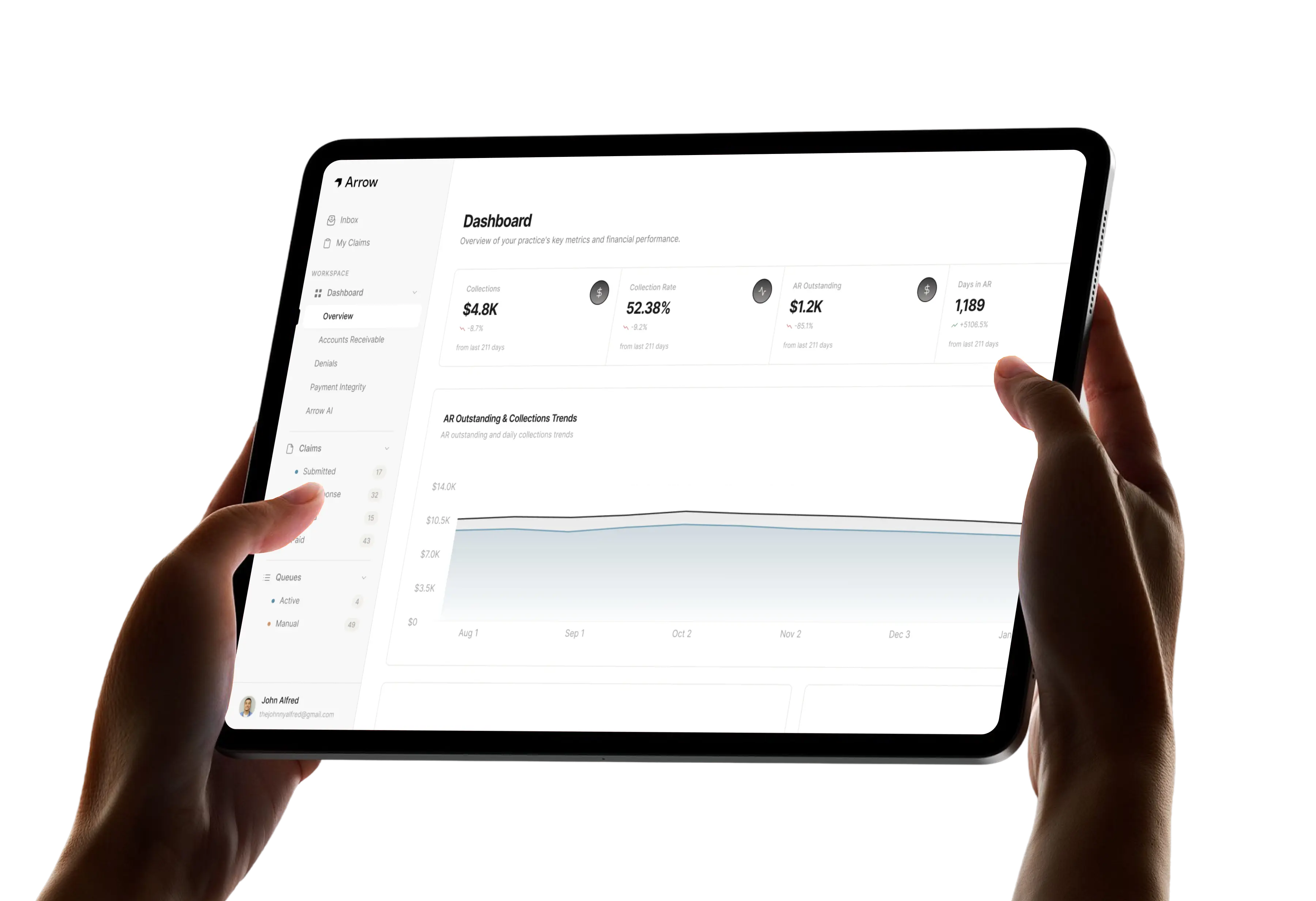
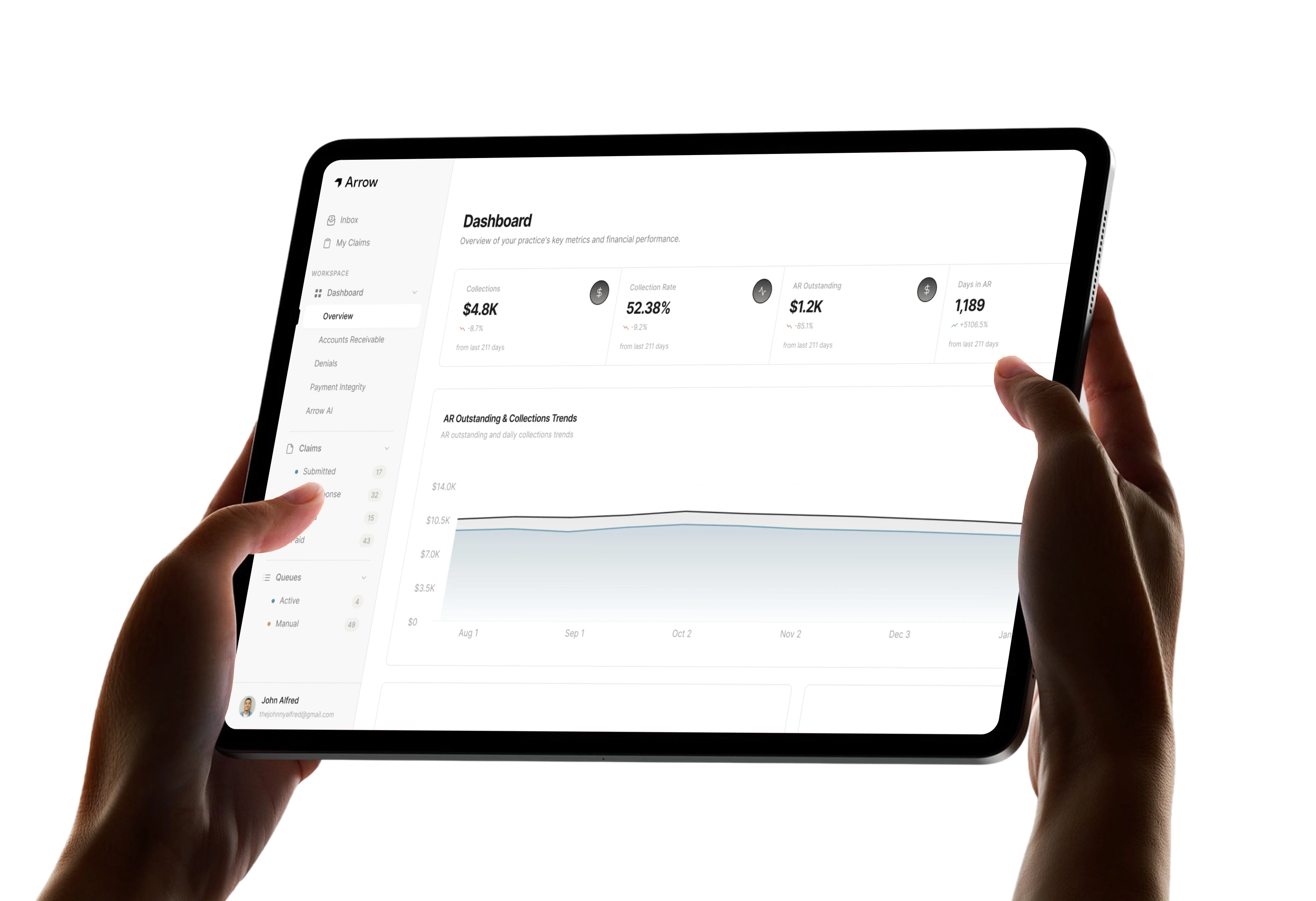
Real-time views of denial trends by payer, root cause, and resolution rate, the same workspace billers use daily doubling as the CFO’s source of truth
System Connectivity Layer
Native and API-based connections into existing EHRs, clearinghouses, and payer portals, so teams keep their current tools instead of migrating off them
Why Human-in-the-Loop, Not Full Automation
A wrong appeal or a bad payer call costs real money, so every claim-affecting action routes through a biller before it goes out. That wasn’t just a compliance requirement; it shaped how the AI itself was built. The system reasons the way an experienced RCM professional already does, so a recommendation reads like a second opinion rather than an instruction to follow. And because every approval or correction feeds back into the model, the platform’s accuracy compounds with use instead of resetting with each new claim. Auditability had to survive that scale too: the same evidence collection and audit trail that covers one claim covers all of them, thousands a day, without anyone having to trust a black box.
Built for Two Very Different Users
Billers and CFOs were never going to trust the platform for the same reasons, so it wasn’t built to convince them the same way.
For billers
a queue already prioritized by dollar value and recovery odds, a drafted fix waiting for approval instead of a blank denial code to research from scratch.
For CFOs and RCM leaders
the exact metrics they’re already measured on, denial rate, A/R days, cost-to-collect, manual effort hours, updating in real time from the same data billers are working from.
The Results
Manual RCM vs. Arrow
 Hours per denial, biller-driven
Separate EHR, clearinghouse, payer portals
Static reports, after the fact
Hours per denial, biller-driven
Separate EHR, clearinghouse, payer portals
Static reports, after the fact
 Seconds, AI-drafted, biller-approved
One workspace connected to all three
Live dashboards, before problems compound
Seconds, AI-drafted, biller-approved
One workspace connected to all three
Live dashboards, before problems compound


Arrow has revolutionized our billing process at MyWellbeing. We've seen a dramatic decrease in denials and a significant speed-up in our revenue cycle. This allows us and our therapists to focus more on providing quality care rather than chasing payments.


What’s Next for Arrow
Frequently Asked Questions
Who built Arrow's AI platform for revenue cycle management?
MindInventory built Arrow's AI platform for healthcare revenue cycle management. The work covered agent architecture, HIPAA-aware infrastructure, EHR and clearinghouse integration, and the denial analytics layer that RCM leads and CFOs use daily. Arrow now supports more than 92,000 clinicians and has processed over 1.5 billion claims.

Can AI agents actually work claim denials end to end?
Yes. Arrow's AI agents, built by MindInventory, read CARC and RARC denial codes off the 835 remittance to find the root cause, correct and resubmit the 837 claim, chase payers for status and underpayments, and hand the case to a human reviewer when confidence drops. Practices on Arrow report an 85% drop in claim denials and A/R days down from 45 to 18.
How do you build a HIPAA-compliant AI platform?
HIPAA compliance is an architecture decision, not something you bolt on before launch. MindInventory built Arrow with audit trails on every agent action, role-based access control, AES-256 encryption at rest and TLS 1.2+ in transit, signed BAAs across the model and infrastructure vendor chain, and a zero-PHI design for OpenRCM, Arrow's free assistant tier.
How do you keep AI agents from making mistakes on live claims?
MindInventory built Arrow so that nothing leaves the system without a human approving it. Agents investigate, diagnose and draft. A biller or RCM lead approves before an appeal gets filed or a payer gets called. Anything the agent is unsure about goes to a person automatically, and every action is logged and traceable for audit.
Can an AI platform integrate with an existing EHR without replacing it?
Yes. MindInventory built Arrow as a connectivity layer that sits on top of the EHR, clearinghouse and payer portals a practice already runs, whether that is Epic, athenahealth or eClinicalWorks on the EHR side and Availity or Change Healthcare on the clearinghouse side, so there is no data migration. In healthcare AI this is usually what decides adoption. Billing teams will not walk away from systems they have used for a decade.
What is agentic AI in revenue cycle management, and how is it different from an AI scribe or an RPA bot?
Agentic AI in revenue cycle management reasons across the full context of a claim and chains several steps together. An AI scribe only automates documentation, and an RPA bot replays a fixed script that breaks the moment a payer portal changes. Arrow's agents run root-cause diagnosis, appeal drafting, payer follow-up and reporting as one human-in-the-loop workflow.
How long does it take to build an AI platform for healthcare?
MindInventory put Arrow's first agent into production in roughly four months, after a six-week phase on discovery and compliance architecture. The platform then expanded over the following months as more EHR, clearinghouse and payer integrations came online. Integration surface and compliance depth drive the timeline far more than feature count does.
What team does a healthcare AI build like this require?
MindInventory ran the Arrow engagement with a dedicated pod of nine: three AI and ML engineers, two backend engineers, one frontend engineer, a DevOps engineer, a QA engineer and a healthcare business analyst. The domain and compliance knowledge has to sit inside the pod from day one. Consulting a specialist at the end is how projects get rebuilt.
Who owns the code and IP in a MindInventory engagement?
Clients own 100% of the source code, the models and the IP. MindInventory works as an extended product engineering team under NDA and a signed BAA, and commits to client-owned repositories from the first day of the engagement.
What other healthcare AI platforms has MindInventory built?
MindInventory has delivered more than 150 healthcare platforms with a team of 126 healthtech specialists. Recent work includes Sully AI's six-agent clinical and administrative workforce, OraQ AI's dental treatment-planning intelligence, ClaimClarity, and Arrow's RCM platform, across HIPAA, GDPR and HITRUST compliance and FHIR, HL7 and DICOM interoperability.