Predictive Analytics Services

We offer AI-powered predictive analytics services that turn historical data into actionable forecasts for demand, customer churn, account risk, and capacity planning. Backed by 2,700+ projects for 1,800+ clients, our teams combine AI engineering, data science, and MLOps to put predictions into the systems your business already runs.

Trusted by Fast-Growing Startups to Established Enterprises

Week 2

A written forecast plan: the decision it serves, the data it needs, the expected gain over today, and a fixed estimate

Before the build

Your current forecast measured, and the cost of over and under forecasting agreed with you

At launch

Forecasts arriving in your planning tool, with a range, not just a single number

At handover

Models, pipelines, and accuracy reports, owned by you

70+

AI and ML specialists

300+

Engineering specialists

2700+

Projects delivered

1800+

Clients served

15+

Years in business

ISO 42001: 2023

ISO 42001: 2023

ISO 27001: 2022

ISO 27001: 2022

SOC2 Type II

SOC2 Type II

HIPAA

HIPAA

BAAs Signed

BAAs Signed

Predictive Analytics Services We Deliver

Our predictive analytics work combines forecasting models, historical and real-time data, and production MLOps to help teams make decisions before outcomes are fixed. As an AI Development Company, MindInventory builds models around the variables that actually influence your business, tests them against a simple baseline, and monitors their performance after deployment so predictions remain useful as conditions change.

Demand Forecasting icon

Demand Forecasting

MindInventory forecasts demand at the level you actually plan: SKU by store, service by region, week by week. Each forecast blends sales history with promotions, prices, holidays, and weather, and comes with a range, so buyers set safety stock from real uncertainty rather than a guess.

Churn Prediction icon

Churn Prediction

Our models score each customer weekly on their likelihood of leaving and surface the signals behind the score, such as falling usage, unresolved support tickets, or an upcoming contract renewal. MindInventory ranks customers by revenue at risk, so retention teams can focus first on the accounts where intervention has the greatest business value.

Risk Scoring icon

Risk Scoring

Risk scoring ranks applications, claims, patients, or accounts by the chance of a bad outcome, with the factors that drove each score. MindInventory sets the cut-off by what a missed risk costs against a false alarm. Where a score decides credit, we build the adverse action reasons US Regulation B requires (12 CFR 1002.9) in from the start.

Capacity Planning icon

Capacity Planning

We forecast the load your operation needs to handle calls, patients, orders, or compute and translate it into the resources required, such as staff, beds, trucks, or servers. MindInventory forecasts at the hourly or daily level your schedule requires and shows the cost trade-off between planning for expected demand and covering the high end of the forecast range.

Forecast Delivery and Planner Integration icon

Forecast Delivery and Planner Integration

A forecast only creates value when it reaches the plan your team actually works from. MindInventory delivers forecasts into your ERP, CRM, BI dashboard, or spreadsheet on the schedule planners use, with every override logged. That history lets you measure whether a planner’s adjustment improved the forecast or made it less accurate.


How We Scope a Predictive Analytics Request

A forecast nobody plans from is just a report. We first place each request into one of six forecast types before quoting, because each requires different historical data, variables, and modeling approaches. MindInventory then checks whether your existing data can answer the business question before modeling begins, so you know what is feasible before investing in development.
Forecast type
Example
What it needs
Volume over time
"How many units will each store sell next week?"
Two or more years of history, promotions and price changes
Who will act
"Which customers will cancel this quarter?"
Customer history with past cancellations recorded
Chance of a bad outcome
"Which claims are likely to be fraudulent?"
Past cases with known outcomes
Load to staff for
"How many patients will arrive Monday morning?"
Hourly or daily arrivals and the rosters behind them
Asset failure
"Which pumps will fail this month?"
Sensor readings plus a maintenance log
Something never seen before
"How will a brand-new product sell?"
Analogous products, or planner judgment with a model alongside

Predictive Analytics Systems We Have Built

We have helped businesses and healthcare teams turn predictive analytics into actionable decisions, from anticipating equipment failures to supporting dental treatment decisions. These case studies showcase how MindInventory builds predictive systems that help teams identify risks earlier and act with greater confidence. 

Smart City Digital Twin: Forecasting City Operations

A UAE urban development authority ran transportation, energy, water, and waste as separate systems with no shared view. MindInventory built a city-scale digital twin on AWS, joining live feeds and geospatial data, with machine learning models that forecast traffic congestion, energy demand, infrastructure performance, and resource use. Operators see the forecast on a 3D command center before the problem reaches the street. The figures are the project's reported results.

Outcomes:

  • 27% fewer unplanned maintenance events
  • 34% faster incident detection
  • City-wide forecasts for traffic, energy demand, and infrastructure
Read Case Study

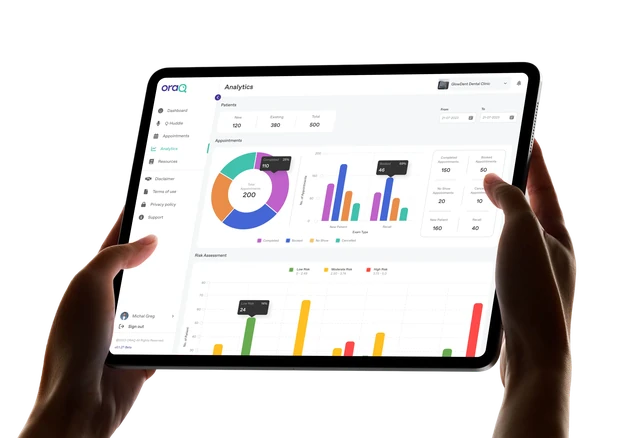
OraQ - Explainable Risk Scoring for Dental Care

Dental exams varied by clinician, with no standard way to combine history, imaging, and findings into one risk picture. MindInventory has worked with OraQ as a dedicated team since 2022, building the risk-scoring models, the digital odontogram and periodontal charting, and integrations into five practice management systems. Dentist and patient review a visual risk profile together, not a black-box number. The figures are OraQ's reported results.

Outcomes:

  • Up to 70% case acceptance, against an industry norm of 30 to 40%
  • $250 to $330 of additional identified treatment per exam
  • 5 practice management systems, live
Read Case Study

Turn Predictive Insights Into Better Business Decisions

Our predictive analytics solutions help you anticipate risks, identify emerging opportunities, and make informed decisions before business conditions change.

Turn Predictive Insights Into Better Business Decisions

What Predictive Analytics Changes for Your Planning

MindInventory’s predictive analytics moves your team from reacting to last month’s numbers to acting on next month’s, with the uncertainty stated up front.
Where you are now
Where you are after launch
We order from last year's sales plus a gut adjustment.
Orders follow a forecast by product and location, with a range for safety stock.
We learn a customer is leaving when they cancel.
The retention team sees at-risk accounts weeks earlier, ranked by revenue.
Every case gets the same review, so risky ones wait in line.
High-risk cases reach a reviewer first, with the reasons attached.
Equipment fails, then we fix it.
Crews service assets the forecast flags before they fail.
Nobody knows if the forecast is any good.
Accuracy is reported every cycle against a simple baseline, in money.

The MindInventory Forecast Contract

Most forecasting projects fail on agreement, not on models: the team builds an accurate forecast for a question nobody asked. MindInventory writes a Forecast Contract with your planners before any modeling, five terms that fix what the forecast is for and how it will be judged. Beat the naive forecast first: if a model cannot beat "same as last week" or "same week last year" on your data, it does not ship, and we tell you so. Everyone agrees what a good forecast looks like before anyone pays for one.

Term

Decision

What we agree

The plan the forecast changes, and who signs it off

Why it matters

A forecast with no decision attached is never used

Term

Horizon and lead time

What we agree

How far ahead, and how early it must arrive

Why it matters

A perfect forecast that lands after the order is placed is worth nothing

Term

Level

What we agree

SKU, store, region, or customer, by day or week

Why it matters

Forecasting at the wrong level makes it unusable for the plan

Term

Baseline

What we agree

Your current method and a naive forecast, measured on the same data

Why it matters

The model must beat both to go live

Term

Cost of error

What we agree

What over forecasting and under forecasting each cost you

Why it matters

Accuracy is scored in money, not only in percent

Bring AI-Powered Predictions Into Your Business Workflows

MindInventory integrates predictive models into your existing systems and workflows, helping your teams act on real-time insights, anticipate changing conditions, and make faster, more informed decisions.

Bring AI-Powered Predictions Into Your Business Workflows

Our Predictive Analytics Process

MindInventory runs every predictive analytics project in six stages, each with a written exit condition, so you can stop after any stage with something useful in hand. One forecast typically reaches production in 8 to 14 weeks.

  1. Step 1

    Forecast Contract

    We agree the decision, horizon, level, baseline, and cost of error with the planners who will use the forecast.

    You receive: a signed Forecast Contract and a fixed estimate

    Typical time: 1 to 2 weeks

    Moves on when: all five terms are agreed

  2. Step 2

    Data Audit

    We check your history for gaps, breaks such as store openings or system changes, and outcomes that were never recorded.

    You receive: a data audit with the gaps to close

    Typical time: 1 to 2 weeks

    Moves on when: the history covers at least one full cycle

  3. Step 3

    Baseline and Drivers

    We score a naive forecast and your current method, then build the drivers that matter: price, promotions, seasonality, and outside signals.

    You receive: baseline accuracy priced in money

    Typical time: 2 to 3 weeks

    Moves on when: the baseline is agreed as the bar to beat

  4. Step 4

    Model Build and Backtest

    We test statistical and machine learning models on past periods the model never saw, at the level you plan.

    You receive: a backtest report against both baselines

    Typical time: 2 to 4 weeks

    Moves on when: one model beats both baselines

  5. Step 5

    Planner Pilot

    The forecast runs beside your current method for at least one planning cycle, with every planner override logged.

    You receive: side-by-side results from a live cycle

    Typical time: 2 to 4 weeks

    Moves on when: planners sign off the forecast

  6. Step 6

    Launch and Monitoring

    Forecasts arrive in your planning tools on schedule, accuracy is reported every cycle, and models retrain when accuracy drops.

    You receive: dashboards, a runbook, and full handover

    Typical time: 1 to 2 weeks, then ongoing

    Moves on when: handover is signed off

How Much Do Predictive Analytics Services Cost?

Predictive analytics at MindInventory runs from under $25,000 for a proof of concept to $150,000 for forecasts across several products, regions, or decisions. Pricing is staged, so you see the gain on your own history before the larger build. Four things move your number: how clean your history is, how fine the forecast level is, how many outside signals it needs, and how many systems it feeds. Plan for 15 to 20% of build cost each year for monitoring and retraining.

Stage
What it covers
Cost
Timeline
Proof of concept
One forecast backtested on your history against today's method
Under $25,000
6 to 10 weeks
Focused solution
One forecast in production, delivered into one planning tool, with monitoring
$25,000 to $60,000
8 to 14 weeks
Production system
Several forecasts or decisions, at fine levels, with automated retraining
$60,000 to $150,000
4 to 8 months

Know What Your Forecast Will Cost

Tell us the decision, the history you hold, and where forecasts need to go. Within two weeks MindInventory returns a fixed estimate and the expected gain over your current method, free of charge.

Know What Your Forecast Will Cost

The Predictive Analytics Stack We Build On

MindInventory picks forecasting tools by the problem, starting with proven statistical libraries and adding machine learning only where it beats them on your data. Forecasts are delivered into the BI tools, ERPs and CRMs your planners already use, so nobody has to learn a new screen.

Statistical forecasting
statsmodels Prophet StatsForecast
Machine learning forecasting
LightGBM XGBoost scikit-learn PyTorch
Data and pipelines
Python dbt Airflow Snowflake BigQuery Databricks
Tracking and monitoring
MLflow Evidently
Delivery to planners
Power BI Tableau Looker ERP and CRM APIs
Cloud
AWS SageMaker Vertex AI Azure Machine Learning

Predictive Analytics We Build for Planning Decisions

MindInventory builds predictive analytics where a plan is set ahead of time and a wrong forecast has a measurable cost. We deliver each forecast into the tools planners already use, with a range around every number and accuracy reported every cycle.

For a UAE urban development authority, we built forecasts for traffic, energy demand, and infrastructure performance inside a city digital twin.
A schema defines what may be returned. A model that can only emit valid fields cannot invent a sixth category
A separate step, outside the call that produced the output, checks claims against the source and numbers against the system of record
“Not supported by the source” is a valid outcome, routed to a person. Most systems have no such path, which is why they guess
For anything entering a record, a named accountable person releases it

Statistical or Machine Learning Forecasting?

MindInventory starts with statistical forecasting and moves to machine learning only when the data earns it. On a single series, a well-tuned seasonal model often matches a complex one at a fraction of the cost.
Statistical forecasting
Machine learning forecasting
Best for
A few series with steady seasonality
Thousands of series, many outside drivers
Data needed
Two or more years of history per series
History across many related series
Explainability
High, trend and season shown directly
Good, with driver contributions per forecast
Watch out for
Misses the effect of price, promotions, and weather
Overfits short or sparse history

When Predictive Analytics Isn't the Right Fit?

Does the model need to score live transactions or read text? If the task is scoring each case in real time rather than forecasting ahead, consider: Machine Learning Development

Is your data too scattered to forecast from? If history sits in systems that do not connect, or outcomes were never recorded, consider: Data Engineering Services

It is also not the right fit if

  • You need to report what happened, not predict what will: that is a BI dashboard
  • You have less than a full seasonal cycle of history
  • The decision is made once a year and the stakes are small
  • Nobody will change a plan because of the forecast
  • Nobody owns a business metric the forecast is expected to improve

Find Out What Your Data Can Predict

Send us one forecast and its history. We’ll assess what approach fits your data and give you a clear recommendation.

Find Out What Your Data Can Predict

Why Choose MindInventory as Your Predictive Analytics Company

MindInventory’s 70+ AI engineers, data scientists, and MLOps specialists work inside a 300+ person engineering organization that also builds the ERPs, apps, and data platforms your forecasts feed.
Decision first

Decision first

Every forecast is tied to a plan and a sign-off before modeling starts.

Measured in money

Measured in money

Accuracy is reported against a naive baseline and priced by the cost of error.

Forecast uncertainty

Forecast uncertainty

Planners see possible outcomes and understand uncertainty in each forecast.

You keep everything

You keep everything

Models, pipelines, and accuracy reports transfer at handover.

Plan Your Forecast, or Fix One Nobody Uses

Starting fresh? MindInventory writes your Forecast Contract in two weeks and returns a forecast plan with a fixed estimate. Already have a forecast planners ignore? We test it against a naive baseline in five working days and tell you why. Both are free.

Plan Your Forecast, or Fix One Nobody Uses

Predictive Analytics FAQs

At least one full seasonal cycle, and two or more years for anything with yearly patterns. Churn and risk models need enough past cases with known outcomes, often a few hundred of the event you want to predict. Short history does not rule out a forecast, but it widens the range. MindInventory checks your history against the forecast you need during the data audit.

It depends on how predictable the thing you forecast is, so MindInventory reports accuracy against a baseline rather than promising a percentage. Before launch you see the model’s error next to a naive forecast and your current method on the same past periods, priced in money. A forecast goes live only if it beats both.

Yes, with less confidence. MindInventory forecasts new products from similar ones that already have history, matched on attributes such as category, price, and channel, then shifts to the product’s own sales as they arrive. Planner judgment often matters most at launch, so overrides are logged and compared against the model.

Yes, and every override should be measured. Planners know things a model does not, such as a competitor closing or a contract won. MindInventory logs each override and reports whether it made the forecast better or worse, so teams keep the adjustments that add value and drop the ones that do not.

As often as the decision needs, usually daily or weekly. Replenishment forecasts often refresh daily, staffing forecasts weekly, and strategic forecasts monthly. Models are retrained on a set schedule and whenever accuracy drops below the agreed threshold, with the new version compared against the current one before it replaces it.

Whatever actually drives the thing you forecast. Prices, promotions, holidays, and weather move retail demand; usage and support tickets move churn; local events and seasons move patient arrivals. MindInventory tests each candidate signal against the baseline and keeps only those that improve accuracy enough to justify maintaining the feed.

Yes. MindInventory delivers forecasts wherever planners already work: your ERP, CRM, a BI dashboard such as Power BI or Tableau, or a shared spreadsheet. Forecasts arrive on the planning schedule with their ranges, and no planner has to learn a new tool to use them.
RELATED AI SERVICES

Explore our other related services to enhance the performance of your digital product

AI Development Services

The full build practice, with cost bands, delivery process and production case studies.

RAG Development

When answers must be grounded in your own documents and cite them.

AI Agent Development

Build intelligent AI agents that automate tasks, make decisions, and improve workflows.

Generative AI Development

Create generative AI solutions for content, automation, personalization, and innovation.

AI insights from our engineering team
Written by the people doing the work, for the questions that come up before a project starts.
post
How to Build an LLM? Definition, Use Cases, and Steps

Developing your enterprise-grade AI solution and need to make it live faster? Let’s opt for ready-to-integrate, general-purpose LLMs! But wait, are you ready to tackle challenges generic LLMs create, like…