Building TaxPlannerPro: A multi-tenant tax advisory platform replacing a legacy filing system
Modernizing TaxPlannerPro for U.S. tax advisory firms: platform re-architecture, applied AI, and multi-tenant SaaS design.
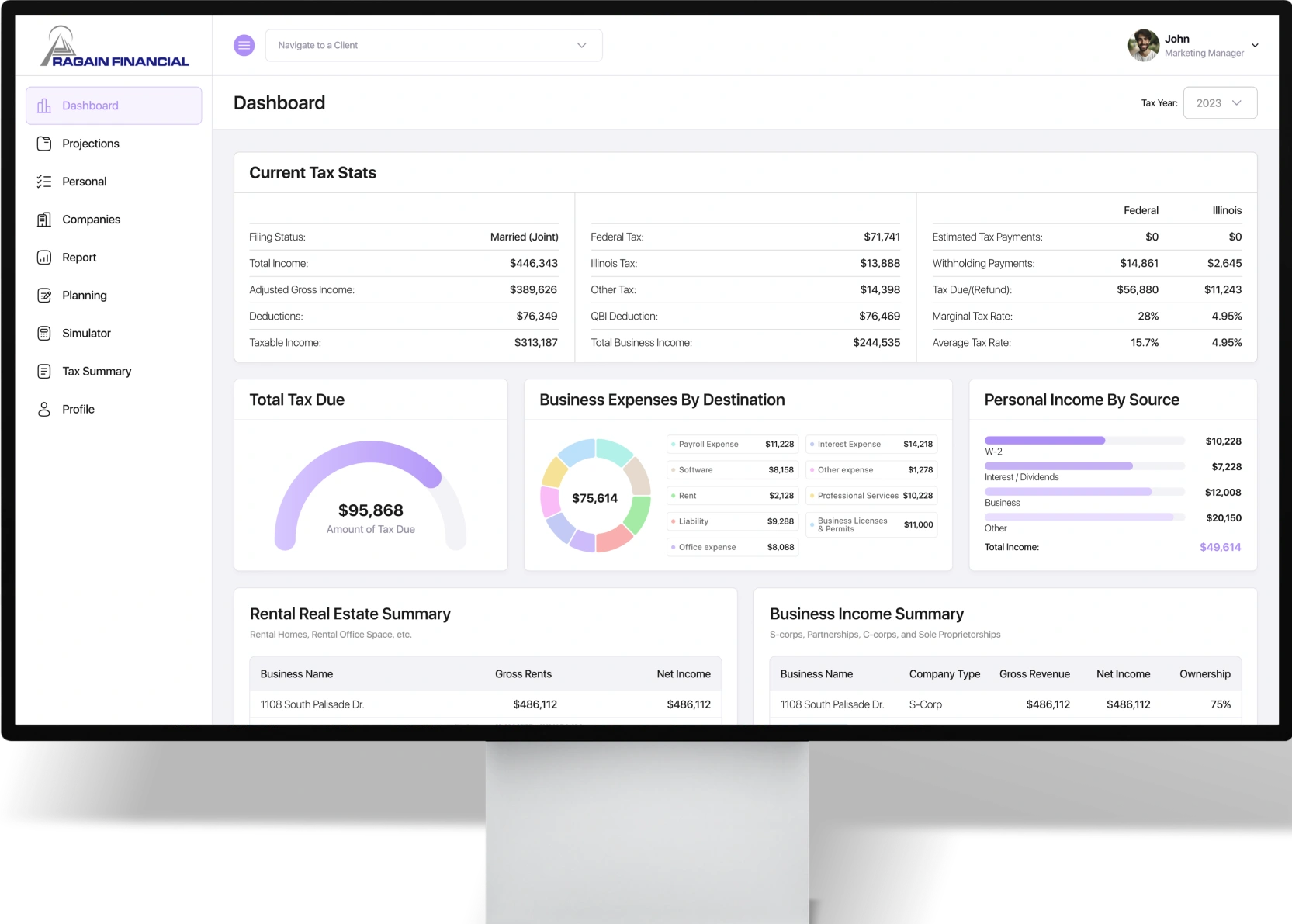

TaxPlannerPro entered its second decade running on first-generation infrastructure: brittle, slow, and increasingly risky to update as tax law changed each year. MindInventory rebuilt it as a cloud-based, multi-tenant advisory platform, spanning Admin, Accountant, and Client portals, with a modular tax engine, AI-assisted document intake, and nine built-in strategy simulations. The client has reported a 50-70% reduction in manual data entry, an 80% gain in advisory efficiency, up to 2x faster scenario turnaround, and an 80% improvement in client retention since launch.
Four structural limits, compounding every tax season
Before the rebuild, TaxPlannerPro's limitations were structural, and they compounded every tax season.
Decade-old technology
Performance degraded as data grew, and even minor features required disproportionate engineering effort to ship safely.
Hard-coded tax logic
Rules lived inside application code, so every annual rule change became a high-risk rewrite with a hard deadline attached.
Fragmented workflow
Client data lived across PDFs, spreadsheets, QuickBooks, and Drake — re-keyed by hand at every step.
Compliance only, no strategy
The tool filed returns. It couldn't model a scenario, compare options, or produce anything a firm could bill advisory work against.
Six capabilities that changed what a firm can sell
MindInventory rebuilt TaxPlannerPro as a continuous decision-support system: advisors ingest client data once, then use it to model, compare, and defend tax strategy year-round, not just at filing time. The product vision centers on one shift: turning tax preparers into tax strategists, without adding headcount.
The platform's Client portal is a meaningful departure from most tax software, which stops at the advisor's desk. It gives firms a self-service experience to offer their own clients, and each firm can run the platform on its own branded subdomain rather than a visibly third-party tool.

Modular tax engine
Federal and state calculations across 1040, 1120S, 1120, and 1065 filings. Rules are configured, not compiled — a new tax year ships without a code release.
AI-assisted data intake
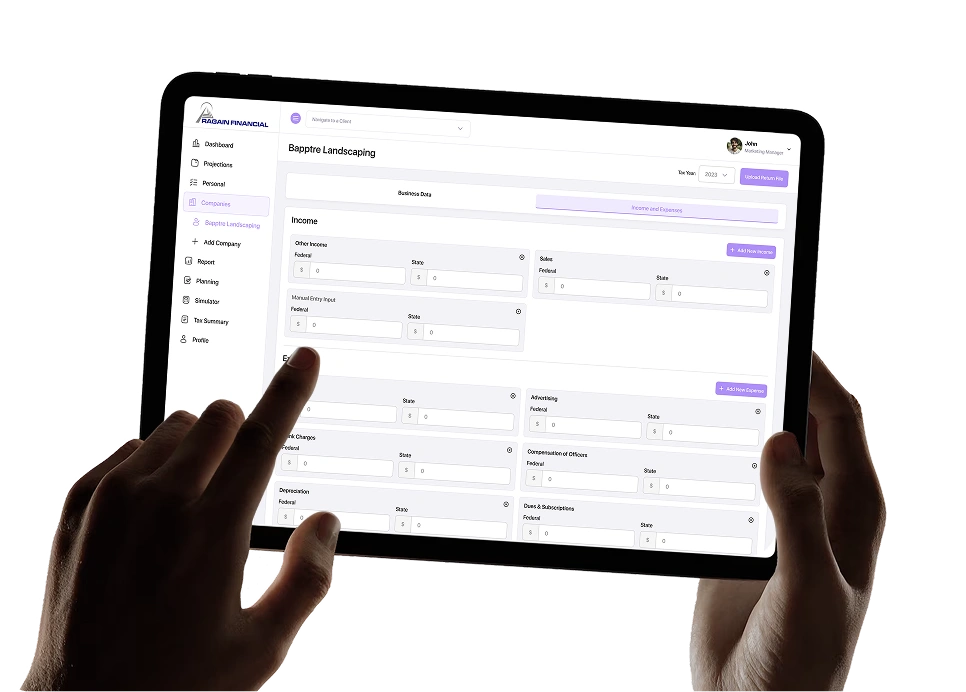
Upload a return instead of typing it. Amazon Textract reads the document, Claude structures it, & an advisor approves every value before it reaches the engine.
Simulation & comparison
Nine strategy modules run against real client data with automatic contribution and eligibility limit checks, then sit side by side for comparison.
Three permissioned portals
Admin, accountant, and client experiences over one dataset. The client portal is the departure — most tax software stops at the advisor's desk.
White-label tenancy
Each firm runs the platform on its own branded subdomain, so the advisory experience reads as the firm's product rather than a vendor's.
Self-service billing
Stripe-backed seat and subscription management. Firms add advisors and change plans themselves; the vendor stays out of the loop.
From onboarding to a client-ready plan
Five stages, each one feeding the next. Data entered at step two is still working at step five.
Onboarding & Client Setup
Firm subscribes, optionally sets up a branded subdomain, and adds clients.
Data Intake
Manual entry or document upload (1040, 1120S, 1120, 1065), with AI extraction and advisor review.
Tax Calculation
Federal and state liability computed across individual and business filing types.
Strategy Simulation & Comparison
Advisors run and compare strategy scenarios, with automatic limit checks.
Client-Ready Reporting
Each strategy produces its own report, shareable through the Client portal.
Technical Foundation & Security
A modular, cloud-native architecture replaced the legacy monolith, so tax logic, document processing, and reporting can each evolve independently. Serverless components absorb bursty document-processing loads during peak filing season without over-provisioning infrastructure year-round.
Role-based access separates what Admin, Accountant, and Client users can see and do, and client data is logically isolated within the multi-tenant architecture. AWS provides encryption in transit and at rest as a standard capability of the services in use.
 React js
 Node.js
 PostgreSQL
 EC2
EC2
 S3
S3
 RDS
RDS
 Lambda
 Claude (Anthropic)
 Amazon Textract
 Stripe
 SendGrid
 QuickBooks Online
 Drake Software
What changed after launch
AI-assisted extraction removed most keying from intake, and with it a common source of transcription error.
The same advisors serve more clients - the outcome that matters most in a market that can't hire enough CPAs.
Building and comparing planning scenarios takes roughly half the time it did, so advice can be produced inside a client meeting.
Proactive, personalised strategy work gives firms a reason to talk to clients between filings - and renewals followed.
| Dimension | Compliance-only software | TaxPlannerPro |
|---|---|---|
| Tax-law updates | Hard-coded; high-risk to change | Modular, admin-configurable engine |
| Client involvement | None; clients wait for a return | Self-service client portal |
| Branding | Vendor-branded | White-labeled on the firm's subdomain |
| Output | A filed return | A filed return plus nine strategy reports |
What this project says about modernization
A rebuild is worth it when it changes what the business can sell, not just how fast the software runs. TaxPlannerPro went from a compliance utility that was turning into a liability to a platform positioned for the advisory-first direction the accounting profession is already moving in.
Because the calculation engine, document pipeline, and reporting layer update independently on serverless-capable infrastructure, new tax years, new strategy modules, and a larger firm base are product decisions now — not rewrites.
Anything that changes on a legislative calendar belongs in configuration, not in a release.
The time sink was data entry, not calculation. Measuring first is what made the AI investment pay.
In regulated work, review steps are a feature. They are what let firms adopt automation at all.
Multi-tenancy and white-labeling built in from day one became a sales advantage, not a migration project.
Questions we get about FinTech platform rebuilds
Have a financial platform that's holding the business back?
We work with FinTech and TaxTech teams on platform re-architecture, AI-assisted workflows, and multi-tenant SaaS products. Tell us where yours is stuck and we'll tell you honestly what it would take.
Start a Conversation