Machine Learning Development Services

MindInventory builds machine learning models that turn your historical data into faster, more consistent decisions: scoring risk, catching fraud and anomalies, recommending the next best product, and reading text at scale. Our 70+ AI engineers, data scientists, and MLOps specialists build each model, explain its predictions, and integrate it into the systems you already run.

Trusted by Fast-Growing Startups to Established Enterprises

Week 2

A written ML plan: the decision the model will change, the data it needs, the expected lift over today, and a fixed estimate

Before training

Today's baseline measured, and the cost of each type of error agreed with you

At launch

The model running inside your systems, with an explanation behind each prediction

At handover

Models, features, training pipelines, and evaluation reports, owned by you

70+

AI and ML specialists

300+

Engineering specialists

2700+

Projects delivered

1800+

Clients served

15+

Years in business

ISO 42001: 2023

ISO 42001: 2023

ISO 27001: 2022

ISO 27001: 2022

ISO 9001: 2015

ISO 9001: 2015

SOC2 Type II

SOC2 Type II

HIPAA

HIPAA

GDPR

GDPR

Our Machine Learning Capabilities

Our experts build machine learning models that learn from your historical data and apply those patterns to new cases: a score, category, ranking, or flag someone can act on. As an AI Development Company, MindInventory delivers seven services, from individual models built on tabular data to deep learning and NLP embedded in your products.

Custom ML Model Development icon

Custom ML Model Development

We build custom ML models for structured data such as transactions, claims, orders, patient records, and sensor readings. For classification, scoring, and ranking, our teams often use gradient-boosted trees such as XGBoost and LightGBM. We also work with your domain experts to define the right features, because the signals an adjuster, clinician, or dentist already relies on can be critical to model performance.

Deep Learning Development icon

Deep Learning Development

Our approach uses deep learning when the data is large, unstructured, or sequential, such as images, audio, long text, clickstreams, and sensor time series. We train models with PyTorch and TensorFlow, starting with pretrained networks where suitable, and recommend deep learning only when its performance gains justify the added compute and lower explainability compared with a simpler baseline.

NLP Development icon

NLP Development

We turn text into structured data your systems can act on, from classifying tickets and claims to extracting entities from notes, scoring sentiment, and routing messages. Our teams fine-tune transformer models on your labeled text and use smaller models when processing volume is high. When a task needs open-ended reading or drafting, we recommend a language model instead of forcing a classifier to do the job.

Recommendation Engines icon

Recommendation Engines

Our teams build recommendation engines that learn from views, saves, purchases, and replies, combining user behavior with item attributes to decide what each person sees next—a product, match, article, or plan. We account for new users and items so the system can still make sensible suggestions with limited history. Before replacing an existing approach, every engine must outperform a simple popularity baseline in a live A/B test.

Fraud Detection ML icon

Fraud Detection ML

We build fraud detection models that score each transaction, claim, or account in milliseconds, letting clear cases pass, stopping likely fraud, and sending uncertain cases to an analyst with reasons attached. Our models are designed for heavily imbalanced data, with thresholds set around the cost of missed fraud versus blocking a legitimate customer, not raw accuracy alone.

Anomaly Detection icon

Anomaly Detection

Our experts build anomaly detection models for cases where few labeled examples exist, learning what normal looks like for each asset or account and flagging meaningful departures. This can include a machine drifting out of range, a spike in refunds, or an unusual login. Each alert includes the underlying readings or signals so your team can understand why it was flagged.

ML Model Integration icon

ML Model Integration

We integrate ML models into the systems where their predictions drive real decisions as real-time APIs, batch jobs that write scores into your CRM, EHR, or ERP, or components inside your app. Each integration includes fallbacks, prediction logging, and the explanation fields your users and auditors need.


How We Scope a Machine Learning Request

If you do not record the outcome, you cannot predict it. MindInventory sorts every request into one of six prediction types before quoting, because each needs different data and a different model, so the model family is chosen by the prediction, not by what is fashionable.
Process type
Example
What it needs
Score
"How likely is this claim to be fraudulent?"
Labeled outcomes and a threshold set by error cost
Classify
"Which team should handle this ticket?"
Labeled examples per category
Rank
"Which five products should this user see?"
Behavior history and a live A/B test
Detect the unusual
"Is this machine drifting out of range?"
A clean record of normal behavior, few labels
Forecast
"What will demand be next quarter?"
Time series history: predictive analytics
Generate language
"Draft a reply to this customer"
Not a scoring model: an LLM

Machine Learning Systems We Have Built

These two projects show machine learning where the prediction changes what a person decides: a dentist planning treatment with a patient, and a user choosing who to meet.

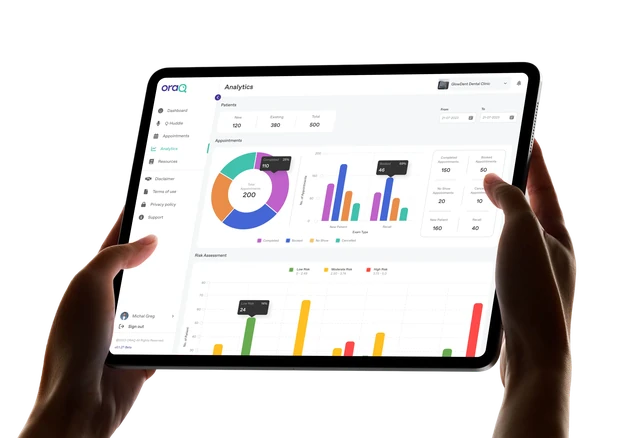
OraQ - Explainable Risk Scoring for Dental Care

Dental exams varied by clinician, with no standard way to combine history, imaging, and findings into one risk picture. MindInventory has worked with OraQ as a dedicated team since 2022, building the risk-scoring models, the digital odontogram and periodontal charting, and integrations into five practice management systems. Dentist and patient review a visual risk profile together, not a black-box number. The figures are OraQ's reported results.

Outcomes:

  • Up to 70% case acceptance, against an industry norm of 30 to 40%
  • $250 to $330 of additional identified treatment per exam
  • 5 practice management systems, live
Read the Case Study

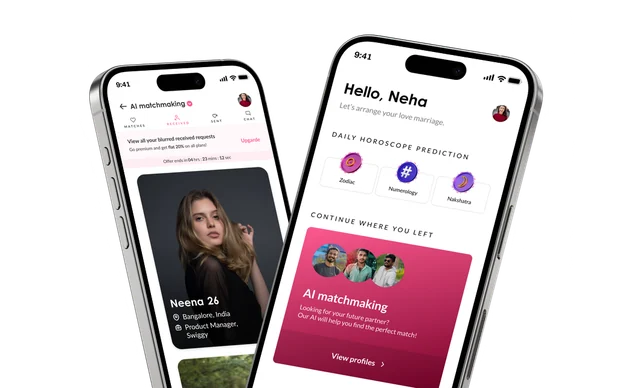
Betterhalf - AI Matchmaking That Learns From Behavior

Betterhalf's matchmaking platform had outgrown its architecture, and match quality depended on what each person actually wanted. MindInventory modernized the platform while it stayed live, refining its AI-driven recommendations from user behavior, strengthening profile verification, and improving performance. The figures are Betterhalf's reported platform results, which the company credits to premium experiences and product improvements as a whole.

Outcomes:

  • 4M+ app downloads
  • 25% revenue growth
  • Behavior-based match recommendations, refined while the platform stayed live
Read the Case Study

Making the Same Decision Thousands of Times a Week?

Tell MindInventory which decision you want to improve and what data you keep about it. In two weeks, free of charge, you get a written ML plan with the expected lift over today, the data gaps to close, and a fixed estimate. If rules or a simple score would do the job, the plan says so.

Glowing AI brain above a circuit platform surrounded by data dashboards, charts and a gear icon

What Machine Learning Changes for Your Business

MindInventory’s machine learning takes repetitive judgment calls off your team and makes them the same way every time, so people spend their attention on the cases a model cannot settle.
Where You Are Now
Where You Are After Launch
Analysts review every case, and the backlog grows each month.
The model clears routine cases, and analysts see only the uncertain ones.
Our rules catch fraud we already know about and miss new patterns.
The model learns new patterns from confirmed cases and flags them early.
Everyone sees the same products, so engagement is flat.
Each user sees recommendations based on what they actually do.
We have a model, but nobody trusts a score they cannot explain.
Every prediction shows the factors behind it.
Our data science team built a model that never left the notebook.
The model runs inside your systems, with monitoring and a retraining path.

The MindInventory Five-Gate ML Test

Most machine learning projects fail before any model is trained, because the decision, the data, or the action was never pinned down. Every MindInventory ML project passes five gates before training, and the feasibility assessment shows which are open and what opening the rest would take. The result: you fund a model only once it has a decision to change, data to learn from, and someone ready to act on it.
Gate
The question we answer with you
If the gate fails
Decision
Is there a decision made often enough that a better prediction changes it?
The model is accurate and nobody uses it
Data
Do you hold enough labeled history of the outcome you want to predict?
Data capture comes first, before any model
Baseline
How well do today's rules or people perform on the same cases?
Nobody can prove the model adds value
Error cost
What does a false alarm cost, and what does a missed case cost?
The model is tuned for accuracy, not for money
Action
Who or what acts on each prediction, and how quickly?
Scores land in a dashboard nobody opens

Model Built, but Nobody Uses Its Predictions?

When a model stalls after training, one of the five gates was usually skipped: there was no decision for it to change, or no one to act on it. MindInventory reviews your model in five working days, free, against the Five-Gate ML Test, and sends a findings document naming what is blocking it and what fixing it takes.

Glowing AI brain on a circuit board surrounded by padlock icons and secure data panels

How We Measure an ML Model Before Launch

A single accuracy number hides the mistakes that cost you most. MindInventory reports six measures on held-out data from your own history, chosen with you before training starts, and a model goes live only when it beats today’s baseline on the measures that matter for the decision. Stability and explanation matter most where the law expects them: the EU AI Act lists creditworthiness scoring and life and health insurance risk pricing among its high-risk uses, and US lenders must give applicants the principal reasons behind an adverse credit decision under Regulation B. After launch the same measures run on live predictions, and drift in any of them triggers a review, which our MLOps consulting team takes on where you need ongoing support.
Measure
What it tells you
Where it matters most
Precision and recall
How many flags are right, and how many real cases the model finds
Fraud, risk, and anomaly detection
Cost-weighted error
What the model's mistakes cost in money, using your error prices
Any decision where errors cost unequal amounts
Calibration
Whether a score of 70 means a 70% chance
Risk scores shown to people, threshold setting
Stability across segments
Whether accuracy holds by region, product, and customer group
Lending, insurance, healthcare, hiring
Explanation quality
Which factors drove each prediction, and whether experts agree
Regulated decisions and user trust
Lift over baseline
How much better the model does than today's rules or team
Every project: the go or no-go number

Our Machine Learning Development Process

MindInventory builds machine learning models in seven stages, from problem framing with the Five-Gate ML Test to monitored production, and every model is measured against your current rules or team before it goes live. One model typically reaches production in 8 to 14 weeks.

  1. Step 1

    Problem Framing and Five-Gate ML Test

    We define what the model predicts, which decision it changes, today's baseline, what each error costs, and who acts on the output.

    You receive: an ML plan and a fixed estimate

    Typical time: 1 to 2 weeks

    Moves on when: all five gates are open

  2. Step 2

    Data Audit and Exploratory Analysis

    We profile every source for completeness, label quality, class balance, time coverage, and leakage, where a field reveals the answer.

    You receive: a data audit report

    Typical time: about 1 week

    Moves on when: the data supports the target, or the gaps are agreed

  3. Step 3

    Data Preparation and Feature Engineering

    We build repeatable pipelines and features with your experts, each computed as it was known at the time of the past case.

    You receive: feature pipelines and a documented feature set

    Typical time: 2 to 3 weeks

    Moves on when: features pass leakage and quality checks

  4. Step 4

    Model Training and Selection

    Train a simple baseline first. Then come gradient-boosted models, and deep learning only where the data justifies it, with time-based validation tracked in MLflow.

    You receive: candidate models with tracked experiments

    Typical time: 2 to 3 weeks

    Moves on when: a candidate beats the baseline on held-out data

  5. Step 5

    Evaluation, Explainability, and Sign-Off

    We report the six launch measures, explain predictions with SHAP, and set the threshold from error costs, with your experts reviewing the explanations.

    You receive: an evaluation report and a model card

    Typical time: 1 to 2 weeks

    Moves on when: experts and the business owner sign off

  6. Step 6

    Deployment, Integration, and A/B Test

    We deploy as a real-time API or batch job through CI/CD, and run it in shadow mode or an A/B test before it takes over.

    You receive: the model in production behind a controlled test

    Typical time: 2 to 3 weeks

    Moves on when: the live test confirms the expected lift

  7. Step 7

    Monitoring and Retraining

    We track data drift, prediction drift, and confirmed outcomes, and a retrained model replaces the current one only if it wins head to head.

    You receive: monitoring dashboards, a retraining pipeline, and full handover

    Typical time: ongoing

    Moves on when: handover is signed off

How Much Does Machine Learning Development Cost?

MindInventory prices machine learning in stages, from under $25,000 for a proof of concept to $150,000 for production ML across several models, so you see the lift on your own data before the larger build. Your number depends on how ready and labeled your data is, real-time or batch predictions, how many models and systems are involved, and how much explanation and regulation the decision carries. Data preparation is often the largest line, and running costs add 15 to 20% of build cost a year.
Stage
What it covers
Cost
Timeline
Proof of concept
One model on your historical data, measured against today's baseline
Under $25,000
6 to 10 weeks
Focused automation
One model in production, integrated with one system, with monitoring
$25,000 to $60,000
8 to 14 weeks
Production automation
Several models or real-time scoring at scale, with retraining pipelines
$60,000 to $150,000
4 to 8 months

How Long Does It Take to Build an ML Model?

A proof of concept takes 6 to 10 weeks, and one model in production takes 8 to 14 weeks. Several models or real-time scoring at scale take 4 to 8 months. Access to clean, labeled history usually sets the pace, not training. The seven stages are set out in Our Machine Learning Development Process above.

 Blue gradient background

Know What Your ML Model Will Cost

Tell us the decision, the data you hold, and where predictions need to go. Within two weeks MindInventory returns a fixed estimate, the expected lift, and a written recommendation, free of charge.

Get my fixed estimate

The Machine Learning Stack We Build On

MindInventory chooses the ML stack per problem, starting with the simplest library that can win and adding deep learning frameworks only where the data needs them. Features, models, and serving stay separate, so a better model can replace the current one without changing the systems that call it. You get models built on open, well-supported tools your own team can maintain after handover.

Machine learning
PyTorch TensorFlow Scikit-learn XGBoost LightGBM
Deep learning
Keras JAX Hugging Face Transformers
NLP
Hugging Face Transformers spaCy sentence-transformers
Recommendation
TensorFlow Recommenders NVIDIA Merlin LightFM
Anomaly and fraud
PyOD CatBoost graph features with Neo4j
Explainability
SHAP LIME InterpretML
Data engineering
Python PySpark Polars Airflow Dagster dbt Databricks Snowflake
Feature stores
Feast Tecton Databricks Feature Store
Experiment tracking and monitoring
MLflow Weights & Biases Evidently
Model serving
FastAPI BentoML Triton Ray Serve
Cloud and MLOps
AWS SageMaker & Bedrock Vertex AI Azure AI Foundry MLflow Kubernetes

Machine Learning We Build for Prediction and Decision Workflows

MindInventory builds machine learning models when historical data can help predict outcomes, identify patterns, score risk, or recommend the next best action. We train and integrate models into the systems where those predictions can support real business decisions, with monitoring and human review where the workflow requires it.

For OraQ, we built machine learning capabilities for patient risk scoring and treatment-planning support, helping dental teams identify relevant clinical patterns.
For Betterhalf, we built recommendation and matching capabilities that use user and behavioral data to personalize experiences and improve relevant matches.
We build models for fraud detection, credit and underwriting risk assessment, claims triage, and other workflows where teams need consistent risk signals.
We apply machine learning to product recommendations, pricing signals, customer behavior, and return-fraud detection.
We use sensor and equipment data to detect anomalies, identify emerging patterns, and flag potential equipment failures before they disrupt operations.
We build predictive models for delivery-time estimation, exception detection, and route anomalies to help teams respond before operational issues escalate.

Classical ML, Deep Learning, or an LLM?

MindInventory starts with the simplest approach that can win on your data, because a gradient-boosted model on clean tabular data often beats a neural network at a fraction of the cost and with far better explanations. The right choice depends on the data you have and the output you need.

Classical ML
Deep learning
Large language model
Best for
Tabular data: transactions, records, sensor readings
Images, audio, long sequences, very large datasets
Reading, summarizing, and drafting language
Data needed
Thousands of labeled rows
Tens of thousands of examples, or a pretrained model
Little to start: instructions and a few examples
Explainability
High, factors shown per prediction
Lower, needs dedicated tools
Good for cited text, poor for numeric scores
Watch out for
Needs careful feature engineering
Compute cost and data hunger
Not built for precise scoring or ranking

When Machine Learning Isn't the Right Fit?

Is the main product the forecast and the planning decisions built around it? If the goal is forecasting future demand, risk, revenue, or other business outcomes and using those forecasts for planning, consider: Predictive Analytics

Does the model need to work with images or camera frames? If the input is visual data that needs to be detected, classified, or analyzed, consider: Computer Vision Development

Does the system need to read, generate, or work with language? If the task is understanding or generating text rather than scoring structured data or predicting an outcome, consider: LLM Development & Fine-Tuning

It Is Also Not the Right Fit If:

  • A clear rule already makes the decision correctly, and nobody disputes it
  • You do not yet record the outcome you want the model to predict
  • The decision happens only a few times a month, so a model is unlikely to pay back
  • Nobody will act on the prediction or change a process because of it
  • Nobody owns a business metric the model is expected to improve

Not Sure Machine Learning Beats Your Rules?

Send MindInventory the decision and a sample of its history. In two weeks, free, you get a written recommendation on whether rules, a classical model, deep learning, or an LLM fits, and a fixed estimate for the one that wins.

Glowing AI brain linked to an envelope and a two-week calendar on a circuit board

Why Choose MindInventory as Your Machine Learning Development Company

MindInventory has built software since 2011, and its 70+ AI engineers, data scientists, and MLOps specialists work inside a 300+ person engineering organization that builds the apps, data platforms, and integrations every model depends on.
Simplest model that wins. icon

Simplest model that wins.

We recommend deep learning only when it beats a simpler model by enough to pay for itself.
Explainable by default. icon

Explainable by default.

Every prediction carries the factors behind it, as on OraQ’s risk profiles.
Measured against today. icon

Measured against today.

No model goes live without beating your current rules or team.
You keep everything. icon

You keep everything.

Models, features, pipelines, and reports transfer at handover.

Plan Your ML Model, or Rescue One That Stalled

Starting fresh? MindInventory assesses one decision in two weeks against the Five-Gate ML Test and returns an ML plan with a fixed estimate. Already have a model stuck in a notebook or ignored in production? We review it in five working days and tell you why. Both are free.

Glowing AI brain above a platform beside a 5 working days calendar and a free gift badge

Machine Learning Development FAQs

Repeated decisions where you have a record of how past cases turned out. Scoring risk, flagging fraud, ranking recommendations, classifying text, and spotting anomalies all fit, because each has many examples of the outcome to learn from. Machine learning is weaker at one-off decisions, problems with no historical outcome, and tasks where a fixed rule is already correct. MindInventory checks the fit with the Five-Gate ML Test.

It depends on the task, but labeled outcomes matter more than total rows. A classification model on tabular data often works with a few thousand labeled cases, while rare events such as fraud need enough positive examples, sometimes a few hundred, to learn from. Deep learning needs more unless a pretrained model fits. MindInventory sizes the data against your accuracy target during the assessment.

Use rules when the logic is known, stable, and agreed. Use machine learning when the pattern is too complex to write down, changes over time, or depends on many signals at once. Most production systems combine both: rules handle hard limits and obvious cases, and the model scores everything in between. MindInventory recommends rules outright when they already perform well.

Yes. MindInventory adds explanations to each prediction with methods such as SHAP, which show the factors that pushed a score up or down. For tabular models these explanations are reliable and readable by non-specialists. Where a decision is regulated, such as credit or insurance, we design the explanation fields with your compliance team so they meet the notice requirements that apply.

By treating imbalance as a design problem, not an afterthought. MindInventory resamples or weights the rare class during training, measures precision and recall instead of overall accuracy, and sets the decision threshold from what each kind of mistake costs you. Confirmed cases from analysts feed back into training, so the model keeps up as fraud patterns change.

By not relying on behavior alone. For a new user, MindInventory’s engines start from what is known, such as sign-up answers, location, or the first few clicks, and blend in popular items until behavior builds up. For a new item, its attributes place it near similar items that already have history. The engine shifts toward personalized suggestions as data arrives.

Typically in milliseconds. A gradient-boosted fraud or risk model served behind an API returns a score in well under 100 milliseconds, fast enough to sit inside a checkout or login flow. Deep learning models take longer and may need GPUs to match that speed. MindInventory sets a latency target for each model and tests it under realistic load before launch.

Yes, and it is a common starting point. MindInventory reviews the model, its data, its features, and how it was evaluated, then compares it against a fresh baseline on the same held-out data. Often the model is sound and the gain comes from better features, a better threshold, or getting it out of the notebook and into production.

Not always. A first model can often be trained on exports from the systems you already run, joined and cleaned for the project. A warehouse or lakehouse becomes worth it when several models need the same data, when predictions must run continuously, or when data quality problems keep repeating. MindInventory tells you which applies during the assessment.

Through whichever path fits the decision. Real-time decisions call the model as an API; overnight decisions receive scores in a batch file or database table that your CRM, ERP, or EHR reads; in-app features embed the model directly. MindInventory adds a fallback for when the model is unavailable and logs every prediction for audit.

Turning text into structured decisions. Common uses are routing support tickets, extracting key facts from claims and medical notes, classifying documents, flagging complaints and risk language, and scoring sentiment in reviews. MindInventory builds these with transformer models trained on your own labeled text, and points open-ended reading and drafting tasks toward language models instead.

By measuring it on live predictions the same way it was measured before launch. MindInventory tracks the six launch measures, input data drift, and confirmed outcomes as they arrive, with alerts when any of them shift. When performance drops, the model is retrained on recent data, compared against the current version, and promoted only if it wins.

RELATED SERVICES

Explore our other related services to enhance the performance of your digital product

AI Insights From Our Engineering Team
Written by the people doing the work, for the questions that come up before a project starts.