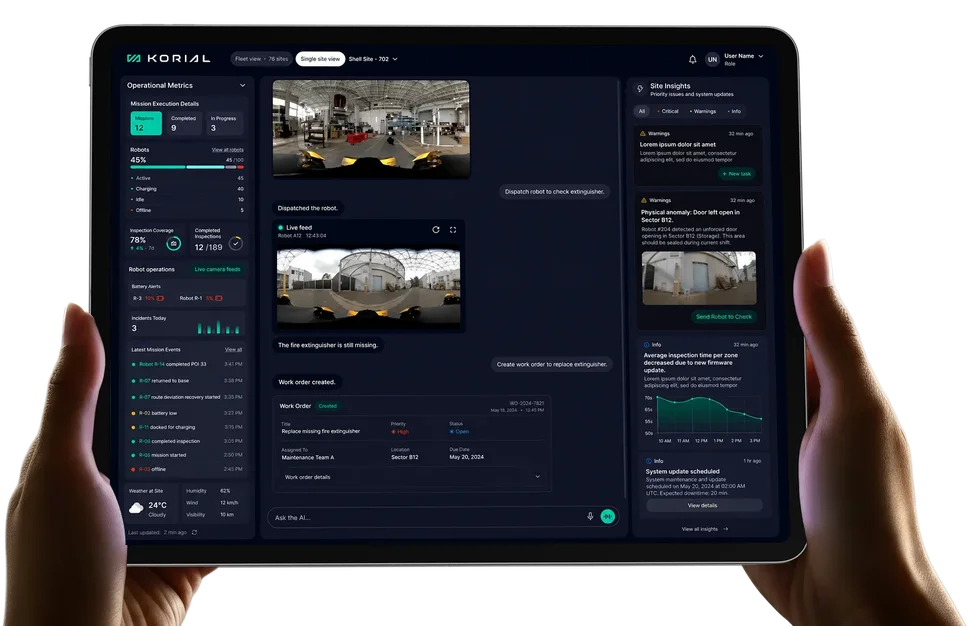


How MindInventory Engineered Korial's Hardware-Agnostic Platform for Autonomous Industrial Inspection
MindInventory partnered with Korial (formerly Energy Robotics), a Darmstadt, Germany-based industrial AI company spun out of the Technical University of Darmstadt, to engineer the enterprise platform that sits above autonomous robots, drones, and sensors — coordinating mixed fleets, simulating missions in a digital twin before they run on live equipment, and turning raw telemetry into decisions an operator can act on. Because the intelligence layer is decoupled from the hardware underneath it, customers can add new robot vendors without rebuilding their workflows. The platform now runs inside energy and chemical majors including Shell, BP, Evonik, and Merck, and has completed over one million autonomous inspections.
Key takeaways

Built a hardware-agnostic intelligence layer, decoupled from any single robot or drone, so customers can adopt new autonomous devices without rebuilding workflows
Engineered a digital twin simulation environment (built in Unreal Engine 5) letting operators validate missions in software before running them on live equipment
Implemented governed agentic AI workflows that convert unpredictable robot telemetry into auditable, human-trusted operational directives
28% reduction in inspection costs, 30% faster mean time to repair, 40,000+ human hours saved, 24/7 autonomous asset monitoring
At a Glance


Product Owner

VP of Product
Reduction in asset inspection costs
Faster mean time to repair (MTTR)
Autonomous asset monitoring
Human hours Saved
Why This Had to Be Built
“As a skilled workforce retires, critical infrastructure operators face a significant demographic shift, compounded by the fact that many of the world’s most vital energy and chemical assets are decades old, requiring more frequent and intricate monitoring.”
MARC DASSLER — CEO, KORIAL
That’s the gap the platform was built to close: aging infrastructure that needs more inspection, not less, running headlong into a shrinking pool of skilled workers willing or able to do manual, often hazardous, inspection rounds.
Robots and drones alone don’t solve that, without a system to coordinate them, plan their missions safely, and turn what they see into decisions someone can act on, autonomous hardware is just an expensive way to collect footage nobody reviews in time.
The Challenge

Fragmented
autonomous ecosystem
Robots, drones, sensors, and enterprise applications operated independently, making it difficult to manage inspections from a single platform
Hardware-dependent inspection operations
Workflows were tightly coupled to specific robots and drones, limiting flexibility and making it hard to adopt new autonomous devices
Unsafe mission
planning and validation
Autonomous missions had to be tested on live equipment, increasing operational risk, deployment cost, and mission failures
Disconnected
inspection data
Images, sensor data, and robot telemetry stayed scattered across systems, making a unified operational view hard to get
Turning telemetry
into trusted decisions
Large volumes of raw robot telemetry needed interpretation before operators could confidently act on it
Scaling across
enterprise assets
Autonomous missions had to be tested on live equipment, increasing operational risk, deployment cost, and mission failures
How an Inspection Mission Runs
Before anything deploys to live equipment, the mission is mapped and validated inside a digital twin environment, an immersive, Unreal Engine 5-built simulation of the actual industrial site.
Ground robots, aerial drones, and fixed cameras execute the mission through one interface, regardless of manufacturer, since the intelligence layer is decoupled from the hardware underneath it.
Before anything deploys to live equipment, the mission is mapped and validated inside a digital twin environment, an immersive, Unreal Engine 5-built simulation of the actual industrial site.
Governed agentic AI workflows convert raw telemetry into bounded, auditable operational directives, the kind of interpretation a human operator can actually trust and act on, not a black-box alert.
Critical anomalies trigger real-time alerts, routing straight to the people who need to act, before a routine issue becomes a safety incident or unplanned downtime.
Operators can query the system in natural language, “what’s the status of Site 4,” “any anomalies this week”, and get an instant operational summary instead of digging through dashboards.
The Results
Reduction in inspection costs
Automating routine monitoring cut manual field visits without sacrificing inspection accuracy
Faster Mean Time to Repair
AI-driven insights and continuous monitoring let maintenance teams detect and resolve issues faster
Autonomous asset monitoring
Round-the-clock visibility into critical infrastructure health that manual inspection rounds couldn’t match
Human hours saved
Field engineers freed from repetitive inspection work to focus on higher-value maintenance and safety priorities







Manual Inspection vs. MindInventory-Engineered Platform
Coverage
Hardware flexibility
Mission risk

Periodic, limited by available staff
Tied to whichever inspector or fixed system is available
New procedures tested on live equipment

Continuous, 24/7 autonomous monitoring
Hardware-agnostic across ground robots, drones, and fixed cameras
Validated first in digital twin simulation
Proven Across Real Industrial Deployments
The platform now runs inside some of the largest names in energy and chemicals. It is live at Shell, BP, Evonik, E.ON, Merck (one of Europe's first industrial adopters of Boston Dynamics' Spot robot), and illwerke vkw, spanning tank farms, refineries, and specialty chemical plants.
“The mixed fleet of autonomous inspection robots and a drone gives us the flexibility we need to inspect a large number of inspection points automatically.”
Built for Operators Who Have to Trust the Output
Nothing in this platform replaces a human’s final judgment call, it’s built to make sure the judgment call is based on interpreted, verified information instead of raw telemetry nobody has time to parse. Every AI-driven directive is bounded and auditable, and Korial’s platform now carries ISO 27001 security certification, the kind of independently audited standard that matters when the platform is handling data from critical energy and chemical infrastructure.
Engineering Decisions Worth Knowing About
A few architectural choices are why this platform holds up at the scale it now runs at.
Decoupling intelligence from hardware, on purpose
Most inspection software of this era was built around a specific robot or drone brand. Building the intelligence layer as its own thing, with standardized integrations underneath, meant a customer could add a new robot vendor without touching their operational workflows. That's the difference between a platform and a hardware add-on.
Kubernetes and Docker for uneven scale
Inspection workloads don't grow smoothly; a new customer deployment can mean dozens of new devices and data streams overnight. Containerized, orchestrated infrastructure lets the platform absorb step-change growth without re-architecture each time an enterprise customer comes online.

Unreal Engine 5 for simulation, not just visualization
A digital twin that just looks realistic isn't enough — it has to be accurate enough that a mission validated in simulation behaves the same way on live equipment. Building in a real-time 3D engine rather than a simplified model made mission rehearsal genuinely predictive.
Agentic AI with bounded outputs
In an industrial safety context, an AI system that occasionally produces an unexplainable recommendation isn't just unhelpful, it's a liability. Defined, auditable output boundaries are what let operators act on AI-generated directives instead of double-checking everything by hand.
What’s Next for the Platform
Deeper enterprise data integration, streaming inspection data, telemetry, and verified insight directly into customers’ existing IT/OT systems and reporting stacks.
Continued expansion of the digital twin environment, extending simulation and mission validation to more site types and asset classes.
Broader hardware ecosystem support, adding new robot and drone integrations as the hardware-agnostic architecture was designed to allow.
Regional data sovereignty, addressing new EU requirements around where inspection and telemetry data is processed and stored.
Frequently Asked Questions
What did MindInventory build for Korial?

MindInventory engineered the enterprise AI platform that unifies autonomous robots, drones, and sensors into a single system: a hardware-agnostic intelligence layer, an Unreal Engine 5 digital twin simulation environment for mission validation, governed agentic AI workflows for interpreting robot telemetry, and the cloud-native infrastructure that runs it at enterprise scale.
What does hardware-agnostic mean for a robotics platform?
A hardware-agnostic robotics platform decouples the higher-level mission planning, fleet management, and AI inspection intelligence from any specific physical robot or drone hardware. This allows enterprise operators to integrate mixed fleets from different manufacturers without locking into a single vendor or re-engineering operational workflows.
How do you build a platform that coordinates robots from different manufacturers?
MindInventory designed a unified API and messaging protocol abstraction layer that standardizes incoming telemetry, sensor data, and control commands across ground robots (like Boston Dynamics' Spot), aerial drones, and fixed sensors. This enables seamless fleet orchestration regardless of the underlying hardware vendor.
What is a digital twin, and why simulate an inspection before running it?
A digital twin is a high-fidelity 3D virtual replica of a physical industrial site. Simulating inspection missions in software prior to real-world execution allows operators to validate navigation routes, sensor coverage, and obstacle avoidance safely without placing physical assets or production environments at risk.
Why use a game engine for industrial simulation?
Game engines like Unreal Engine 5 provide real-time physics, high-performance rendering, and accurate spatial lighting out of the box. Using Unreal Engine 5 allowed us to build highly realistic digital twins that simulate real-world environmental lighting and physical constraints accurately for mission rehearsals.
Can AI be trusted to interpret industrial inspection data?
Yes, when engineered with strict governance and bounded output parameters. The platform utilizes human-in-the-loop agentic AI workflows that interpret sensor telemetry into clear, auditable operational directives, ensuring human operators retain complete control and oversight over critical maintenance decisions.
How do you scale a platform when workloads arrive in step changes?
The platform leverages containerized, cloud-native microservices orchestrated with Kubernetes and Docker on AWS. This infrastructure automatically scales compute resources to absorb sudden surges in data volume whenever a new industrial facility or robot fleet comes online.
What results has the platform delivered?
Korial's platform has achieved a 28% reduction in asset inspection costs, a 30% reduction in Mean Time to Repair (MTTR), over 40,000 human hours saved, and completed over 1,000,000 autonomous inspections across energy and chemical facilities worldwide.
Which companies use Korial's platform?
The platform is actively deployed at global energy and chemical leaders including Shell, BP, Evonik, E.ON, Merck, and illwerke vkw.
Can MindInventory build an industrial or robotics AI platform for us?
Yes. MindInventory specializes in end-to-end product engineering for AI, robotics, digital twins, and enterprise cloud applications. We've built similar platforms across industries — including SullyAI (sully.ai), an AI agent for clinical documentation in healthcare, and Arrow (arrowhq.com), an agentic AI platform for healthcare revenue cycle management. Contact our engineering team to discuss your project requirements.