






Healthcare AI Development Company

MindInventory combines HIPAA Compliant Software Development with healthcare AI expertise to build HIPAA-compliant AI agents, clinical copilots, and healthcare AI systems for healthtech companies, healthcare providers, and organizations building AI-powered products. We connect AI to the workflows, data, and systems your teams already use, with the guardrails, evaluation, and monitoring needed for reliable production use.

Reviewed by Last reviewed: September 2026
Parth Pandya
Parth Pandya Senior Project Manager
Nihir Patel
Nihir Patel Healthcare Technology Expert
Healthcare AI Development Company
Trusted by Global Healthcare Services Providers, Medical Device Manufacturers, and Clinicians
Sully.ai
Passio
OraQ
SensorBio
Claim Clarity
Shoorah
Sully.ai
Passio
70+

AI engineers, data scientists and MLOps specialists

1.5B+

Claims processed through AI we built

100+

Healthcare organisations running our AI in production

ISO 42001

Certified for AI management systems

ISO 42001
ISO 13485:2016
HITRUST
AICPA SOC 2
CERTIFIED ISO 27001:2022 COMPANY
CERTIFIED ISO 9001:2015 COMPANY

Healthcare AI We Build to Improve How Healthcare Works

Sully.ai — Six Clinical AI Agents With an Orchestration Layer

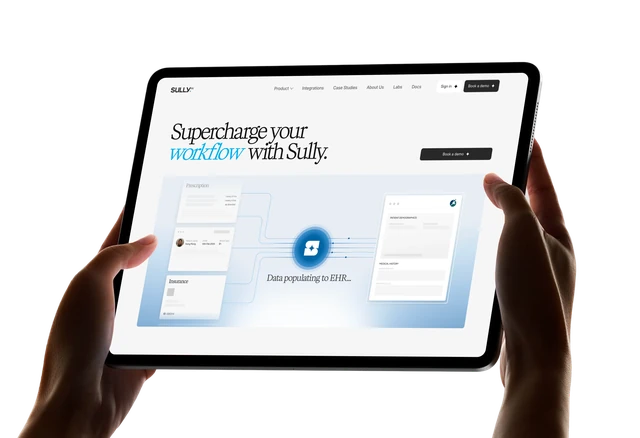
A US healthcare SaaS company wanted clinicians to have a team of AI colleagues rather than one more tool to open. We built six purpose-specific, Docker-isolated agents covering reception, triage, scribing, clinical consultation, medical coding and care coordination, plus an orchestration layer that decides which agent handles a given task. It runs natively inside Epic and athenahealth, with human review on every clinical output.

Outcomes:

12.5M+ minutes of clinical documentation automated
21x return on agent spend
Used across 100+ healthcare organisations and 30,000+ providers

Read the case study

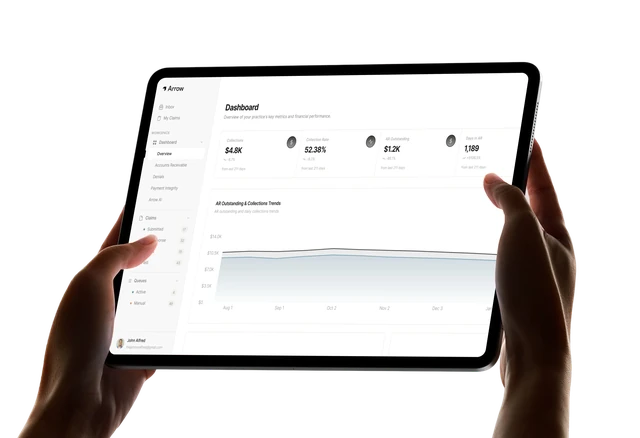
ArrowHQ — Human-in-the-loop AI for Claim Denials

MindInventory built a human-in-the-loop AI platform that automates the claim-denial workflow for ArrowHQ, connecting the EHR, clearinghouses, and payer systems the client already used. The six-step agent workflow ingest, diagnose, prepare, review, act, and track uses Pinecone vector search and SQS queuing to gather evidence, prepare claim actions, and move cases through the denial workflow. Billers review and approve every claim action before it executes, keeping human oversight in the loop.

Outcomes:

85% reduction in claim denials
Accounts receivable days cut from 45 to 18
1.5B+ claims processed through the platform
Read the case study

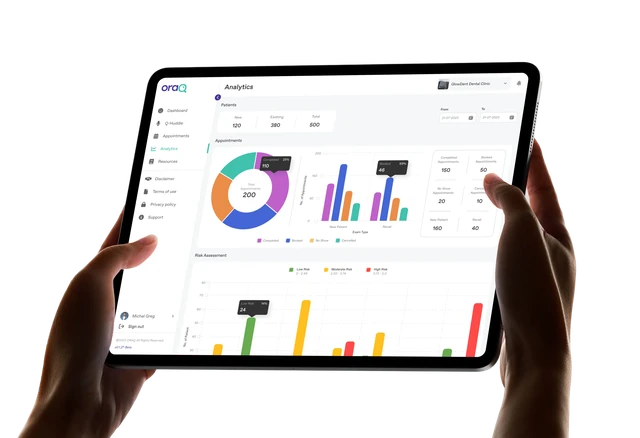
OraQ AI — Clinical Risk Scoring Inside Dental Practice Systems

MindInventory built an AI-powered dental assessment platform that turns patient history, dental imaging, and clinical findings into risk-based assessments for dentists and dental practices. We engineered the risk-scoring models, digital odontogram, and periodontal charting, and integrated the platform with practice management systems including Dentrix, OpenDental, ClearDent, Curve, and Eaglesoft. The architecture was designed to support FDA and Health Canada clearance, while keeping clinical assessment within the systems dental practices already use.

Outcomes:

Case acceptance lifted from 30–40% to 70%
$250 to $330 of additional identified treatment per exam
Live inside five practice management systems: Dentrix, OpenDental, ClearDent, Curve and Eaglesoft
Read the case study

Have an AI Pilot that Never Made it to Production?

That is the most common conversation we have. Tell us where it stalled and we'll tell you whether it's a data problem, an integration problem or a governance one.

Healthcare specialist reviewing medical data

Why Healthcare AI Struggles to Reach Production

Most healthcare AI projects don’t start from zero. When teams come to MindInventory, they often already have a promising proof of concept built internally or by another consultancy, demonstrated successfully and then left short of production.

Doctor using AI in futuristic healthcare environment

The gap is rarely the AI model alone. From the healthcare AI systems we’ve taken into production, we’ve seen that the harder work is connecting AI to clinical workflows, integrating existing healthcare systems, meeting security and regulatory requirements, and applying Healthcare Software Development practices that keep the system reliable after deployment.

A prototype can demonstrate what AI can do. Production requires the engineering, integrations, guardrails, and monitoring that make it work safely in the real healthcare environment.

Across the healthcare AI projects we’ve helped move toward production, four barriers come up repeatedly:
hard-drives

The data

The pilot ran on a clean sample. Production clinical data turned out to be inconsistent, unstructured, spread across systems, and full of the free-text notes nobody standardised.

tree-structure

The integration

The model worked. Nothing connected it to the EHR clinicians actually use, so using it meant leaving the chart, and clinicians stopped.

files

The evidence

There was no evaluation harness, so when someone changed a prompt nobody could prove whether accuracy improved or degraded. Without that, a clinical governance committee has nothing to approve.

gavel

The governance

Legal asked where the PHI goes, whether the vendor signs a BAA, and who is accountable for a wrong output. The room went quiet.

None of those are AI problems. They are engineering and governance problems, which is why healthcare AI engagements with us open with a readiness assessment instead of a build quote. If the data pipeline isn't there, a better model won't rescue the project. It will fail at a higher cost.

AI READINESS CHECK

FREE DIAGNOSTIC

IS YOUR ORGANISATION ACTUALLY READY FOR CLINICAL AI?

1-minute readiness check based on the areas we assess before building healthcare AI. Answer four questions about your data, integrations, AI maturity, and governance to get a directional readiness score before committing budget to a vendor, including MindInventory.

QUESTION 1 OF 4

How would you describe your clinical and operational data?

Healthcare AI We Build Around Your Workflows

At MindInventory, we build healthcare AI around how your teams work. Our systems fit your clinical workflows, business processes, existing technology, and the decisions your organization needs AI to support.
01

Clinical and Administrative AI Agents

We engineer single-agent and multi-agent AI systems around your workflows, automating tasks from patient reception and triage to scheduling, coding, prior authorization, care coordination, or denial management. Our AI Agent Development approach enables AI copilots to work directly inside the products your teams already use. For workflows involving clinical or financial decisions, we design human review and approval into the system rather than relying on unsupervised AI outputs.
02

Clinical Decision Support and Risk Models

We develop clinical decision support and risk models around your intended use, clinical workflow, and regulatory requirements. Use cases include risk scoring, deterioration prediction, readmission risk, cohort identification, or imaging triage. The architecture keeps clinicians in control of final decisions while giving them AI-generated insights where they fit into the workflow.
03

LLM and Retrieval Systems

We engineer LLM and retrieval-augmented generation (RAG) systems using the clinical documents, guidelines, policies, payer rules, or other domain-specific knowledge relevant to your application. Our RAG Development Services include evaluating retrieval, prompting, and model performance against your use case before recommending fine-tuning, helping you choose the approach that solves the actual problem without unnecessary complexity.
04

Healthcare Conversational and Voice AI

We design patient-facing chatbots, voice agents, symptom guidance systems, appointment assistants, or staff-facing conversational AI around your communication workflows. Each system includes defined escalation paths and clear boundaries between general health information and medical advice. These controls are built into the architecture to support safer interactions rather than relying on prompting alone.
05

Computer Vision and Document Intelligence

We apply medical imaging, biosignal processing, or document intelligence to the clinical inputs your product or workflow depends on, supported by our Computer Vision Software Development Services. This can include processing imaging and biosignals or extracting structured information from referrals, faxes, clinical documents, and correspondence for the next step in your healthcare workflow.
06

AI Integration and MLOps

We integrate AI with the EHRs, clearinghouses, practice management platforms, or healthcare applications your teams already rely on including legacy systems that were never designed for AI. We then engineer the evaluation, monitoring, versioning, retraining, and rollback infrastructure needed to keep your AI system reliable after launch.

Not Sure Which of These Your Problem Needs?

Describe the workflow and we'll tell you whether it calls for an agent, a model, better retrieval, or nothing yet.

Healthcare specialist reviewing medical data

How We Keep Your Clinical AI Safe

This is the question every clinical governance committee asks, and it deserves a real answer rather than a reassurance. We handle it structurally, not through prompting.

Check Icon

The model invents an answer

Retrieval grounds every answer in your source documents, never in model memory. Output schemas constrain what the model is allowed to return. A validation layer checks claims against the retrieved source before anything reaches a user.

Check Icon

Nobody can prove it still works

An evaluation harness scores outputs against a fixed clinical benchmark, so any prompt or model change is measured, not argued about. The harness transfers to you with the code.

Check Icon

An agent takes an action it shouldn't

High-risk actions require human confirmation before execution, never after. Clinical and financial decisions stay with a named person. Every agent action is logged and attributable.

Check Icon

Accuracy decays after launch

Drift monitoring flags when live data diverges from what the model was built on, with retraining pipelines and versioned rollback already in place.

Check Icon

PHI ends up somewhere it shouldn't

BAA signed before any PHI access. De-identified (Safe Harbor or Expert Determination) or synthetic data used in development wherever the use case allows. Encryption at rest and in transit, role-based access, full audit logging, inside our ISO 27001 and SOC 2 Type II controls.

Check Icon

An agent is manipulated through its own inputs

Prompt injection is a live risk once an agent reads untrusted content such as patient messages, faxes or payer correspondence. Tool access is scoped to the minimum each agent needs, untrusted input is separated from instructions, and no agent can widen its own permissions.

Check Icon

Nobody owns it after go-live

MLOps is inside the engagement, and the models, pipelines and evaluation harnesses are yours, so your team can run them without us.

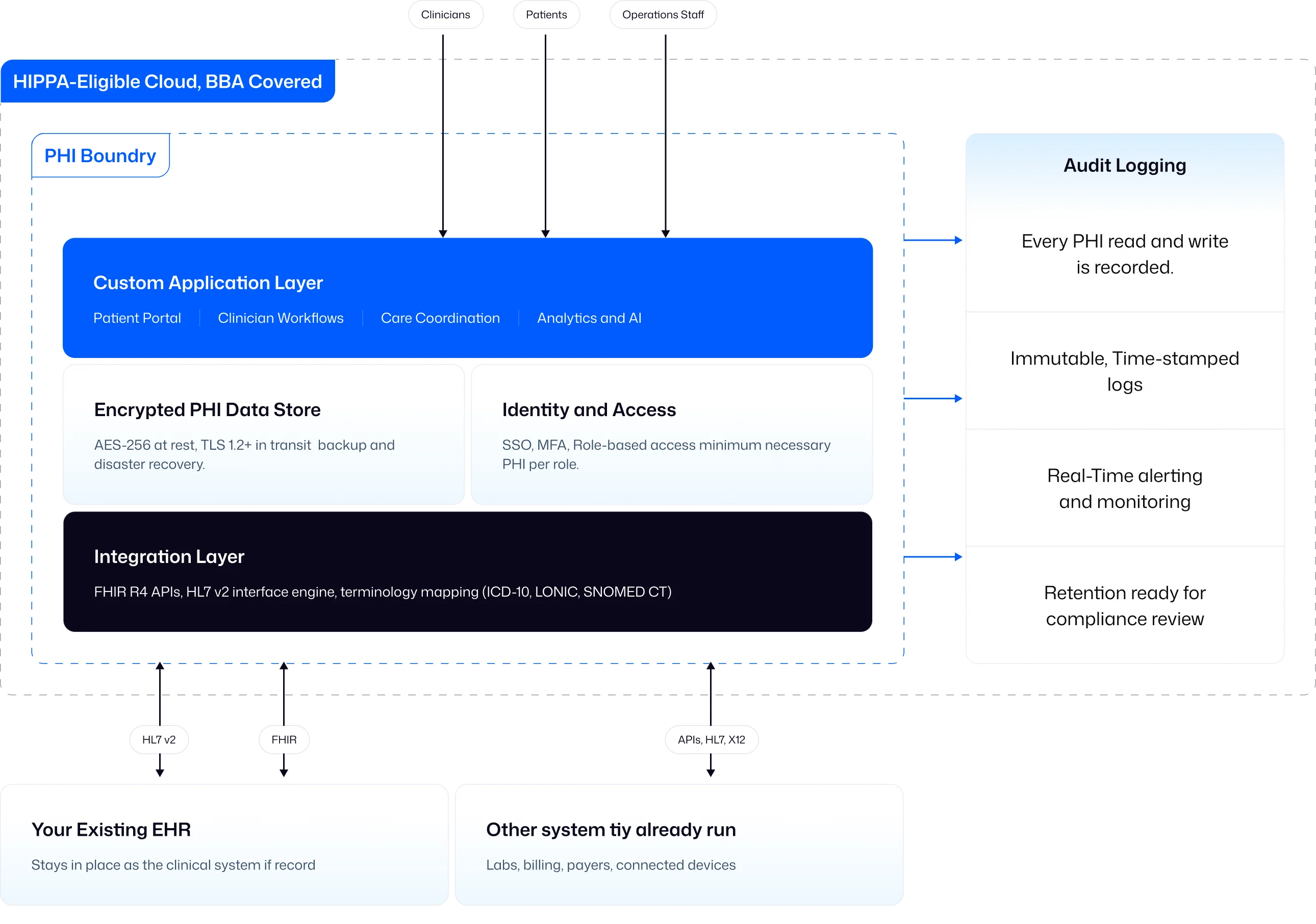
How a clinical AI agent fits into your existing healthcare stack

The agent connects to your EHR through FHIR, retrieves knowledge from your document store, routes outputs through validation and guardrails, then escalates high-risk actions to a human reviewer. Within the BAA-covered boundary, interactions are secured and audit-logged for traceability.

Healthcare AI Architecture Diagram
Dashed Line PHI Boundary
Blue Dashed Line BAA-Covered Cloud
Black Arrow Encrypted Data Exchange
Blue Arrow Audit Event

Build Your Own or Buy an AI Product?

Buying an AI product can make sense when your needs fit an existing platform. Building can make more sense when your workflows, integrations, data, or governance requirements need greater control. MindInventory builds healthcare AI around your specific requirements rather than asking your teams to adapt to a generic product.

If a product genuinely covers your case, we’ll say so during scoping. We’d rather tell you that in week one than build something you didn’t need.
Best when
Speed to first value
Fit to your workflow
Integration depth
What you own
Cost shape
Main risk
Buy a vendor AI product
The workflow is standard and you want it running this quarter
Fastest
You adapt to the product
Whatever the vendor exposes
A subscription
Per seat or per transaction, forever
Vendor roadmap and pricing changes are outside your control
Build with us
The workflow is yours, or the AI is part of a product you sell
Proof of concept in 6 to 10 weeks
Built around how your teams already work
Anything reachable via HL7, FHIR or API, including legacy systems
Source code, model weights, pipelines and evaluation harnesses
Build cost, then your own running cost
Underestimating data readiness and integration effort

We Prove the Approach Before Building for Production

asterisk

We don't take your healthcare AI project from proposal straight into a production build. We first validate the approach with a proof of concept using your data, typically under $25,000 over six to ten weeks.

The PoC tests three things:

  • asterisk
    Whether your data supports the use case
  • asterisk
    Whether the model reaches an accuracy level clinicians can act on
  • asterisk
    What the required integrations will actually involve.
asterisk

If the approach doesn't hold up, we'll tell you before you commit to a larger build. A PoC that shows what won't work can save months of development effort and that is exactly what it is designed to do.

Compliance and Ownership

Compliance and Governance For Healthcare AI

HIPAA compliance is not a certification a vendor can claim it depends on how your AI system handles PHI, controls access, protects data, maintains audit logs, and manages contractual obligations such as BAAs. We design these controls into the architecture from the start.

Independent certifications apply to the security, quality, and management systems surrounding the technology. The certifications below demonstrate the frameworks and controls supporting how we build and operate healthcare AI.

AI management systems. The only certification specific to how AI is governed, and still rare among development partners.

AI management systems. The only certification specific to how AI is governed, and still rare among development partners.

Security, availability and confidentiality controls, audited over months, not a single date

Security, availability and confidentiality controls, audited over months, not a single date

Information security management

Information security management

Medical device quality management, for AI that falls under SaMD

Medical device quality management, for AI that falls under SaMD

Healthcare security and privacy, the framework US health systems assess vendors against

Healthcare security and privacy, the framework US health systems assess vendors against

Quality management

Quality management

Governance Frameworks We Work To

NIST AI Risk Management Framework · ISO 42001 controls · EU AI Act risk classification for systems used in Europe · model cards and documented evaluation results for clinical governance review

HIPAA
HIPAA
EU MDR
EU MDR
HITECH
HITECH
CMS Interoperability Rule
GDPR
GDPR
HL7 v2
HL7 v2
42 CFR Part 2
42 CFR Part 2
FHIR R4/R5
FHIR R4/R5
FDA SaMD
FDA SaMD
SMART on FHIR
SMART on FHIR
IEC 62304
IEC 62304
CDS Hooks
CDS Hooks
ISO 14971
ISO 14971

How Much Does Healthcare AI Development Cost?

Engagement type
Typical cost
Typical timeline
AI readiness assessment and roadmap
Scoped per engagement
2 – 4 weeks
Proof of concept on your own data
Under $15,000
6 – 10 weeks
Production AI system
$20,000 – $100,000
3 – 8 months to first release
Multi-agent platform with EHR integration
$100,000+
8 – 12+ months
AI classified as SaMD
$200,000+
12+ months including clearance

What moves the number most

Data readiness, integration complexity and regulatory scope. Model choice barely registers. Anything touching clinical or financial records takes longer, because compliance review runs alongside development, not after it.

Every engagement starts with discovery that produces a fixed estimate before development begins.

What Would It Take to Build Your AI?

Send us the use case and we'll come back within 24 hours with an indicative cost, an indicative timeline, and what we'd need to firm both up.

Healthcare specialist reviewing medical data

How a Healthcare AI Engagement Runs

Step 1

Paperwork First

BAA and NDA signed before we see PHI, sample data or production systems.
Step 2

Readiness Assessment

We look at your data, your integration surface, your governance position and your team’s ability to operate what gets built. The output is a roadmap with prioritised use cases, and an honest read on whether to start now or fix foundations first.
Step 3

Regulatory Classification

We settle what the AI is from a regulatory standpoint before architecture decision support or SaMD, what risk class applies, and where the EU AI Act lands if you operate in Europe. This decides how rigorous everything downstream needs to be.
Step 4

Proof of Concept on Your Data

Six to ten weeks, run against your real clinical data, never a clean sample, with an accuracy benchmark agreed upfront so the result is a measurement and not an opinion.
Step 5

Production Build with Clinical Review

Two-week cycles with clinical and compliance stakeholders reviewing model outputs alongside features. We schedule those reviews around clinical shifts, because a review a clinician can’t attend tells you nothing.
Step 6

Validation and Controlled Go-live

Evaluation harness run against the agreed benchmark, human-in-the-loop controls verified, audit logging confirmed, then a staged rollout with extra support through the first weeks.
Step 7

MLOps and Monitoring

Drift monitoring, retraining pipelines, versioning and rollback, because a clinical AI system that quietly loses accuracy is a patient-safety issue before it is a support ticket.

Why Healthcare Companies Choose MindInventory for AI

Built for Production, Not Just Pilots

Built for Production, Not Just Pilots

Our healthcare AI work is built for real-world use, with documented outcomes from named client engagements. Our production experience spans AI platforms used across 100+ healthcare organizations not just isolated proofs of concept.
AI Governance You Can Verify

AI Governance You Can Verify

Our ISO 42001 certification provides an independently assessed framework for managing AI-related risks, governance, and processes. For your clinical and compliance teams, that gives them documented controls to review as part of your AI governance process.
Your AI, Your Assets

Your AI, Your Assets

Your delivered system includes the source code, trained model weights, pipelines, evaluation assets, and technical documentation agreed as part of the engagement. The goal is straightforward your organization can operate, maintain, and evolve its AI without being locked into MindInventory.
We Tell You When Not to Build

We Tell You When Not to Build

If your data isn’t ready, an existing product fits your needs better, or a proof of concept shows the approach won’t work, we’ll tell you before you commit to a larger build. We see honest technical guidance as part of the engagement not an obstacle to closing one.

Meet the Team Behind Your Healthcare AI

You work with a dedicated AI practice of 70+ AI engineers, data scientists, and MLOps specialists focused full-time on AI and data engagements, backed by a wider engineering organization.

Your healthcare AI team can include

AI solution architect
ML engineers
Data engineer
MLOps engineer
Healthcare business analyst
QA engineer with clinical testing experience
Project manager experienced in regulated healthcare delivery

The difference is not just who builds the model. Your team needs people who can connect it to your EHR, data infrastructure, clinical workflows, and production environment. That integration experience is often what turns a working model into a system your organization can actually use.

Team image

Technologies We Use to Build Healthcare AI

GenAI Platforms

OpenAI
Microsoft Foundry
Amazon Bedrock
Google Vertex AI
OCI Generative AI
Hugging Face

Healthcare LLMs

MedGemma
MedLM
BioMedLM

Agents & orchestration

OpenAI Agents SDK
Bedrock Agents
Google ADK
LangChain
LangGraph
Dify
n8n

Retrieval & Vector Search

Pinecone
pgvector
OpenSearch
FAISS

ML Frameworks

PyTorch
TensorFlow
Keras
Scikit-learn
OpenCV
spaCy
Apache Spark MLlib

Output Validation & Guardrails

Microsoft Guidance
IBM AI Fairness 360
Evaluate
Guardrails AI

EHR/EMR Platforms

Epic
Oracle Health (Cerner)
MEDITECH
athenahealth
NextGen
Allscripts

Interoperability

HL7 v2
FHIR R4/R5
SMART on FHIR
CDS Hooks
USCDI
CCDA
DICOM
Mirth Connect
Redox

Back-end

Python
Node.js
PHP
Golang

Cloud Platforms

AWS
Microsoft Azure
Google Cloud Platform
under BAA-covered configurations

Data & Analytics

Snowflake
Redshift
Azure Synapse
Databricks
S3
Azure Data Lake

MLOps & Monitoring

Prometheus
Grafana
Datadog
Elastic Stack
model versioning and drift monitoring

FREQUENTLY ASKED QUESTIONS

Here’s a list of FAQs that will help you to know more about MindInventory.

Healthcare AI development is the process of building and deploying AI systems for clinical, administrative, and operational healthcare workflows. It includes AI agents, clinical copilots, decision-support and risk models, healthcare chatbots, document intelligence, and AI systems integrated with EHRs. Healthcare AI development also requires HIPAA-compliant data handling, HL7/FHIR interoperability, human oversight, regulatory controls, and MLOps for monitoring AI performance after deployment.

Yes. An AI system can be designed to support HIPAA compliance when it uses appropriate safeguards for protected health information (PHI). Key controls include a Business Associate Agreement (BAA), encryption in transit and at rest, role-based access, audit logging, minimum-necessary access, and clear controls over whether PHI is used for model training. HIPAA does not provide a vendor or product certification, so “HIPAA certified” is not an official certification.

Healthcare AI development typically costs $25,000–$150,000 for production systems, while a proof of concept (PoC) using your data can cost under $25,000 and take six to ten weeks. Complex multi-agent platforms with deep EHR integration can cost more, while AI classified as Software as a Medical Device (SaMD) may start around $200,000 when regulatory clearance is included. Cost depends mainly on data readiness, integration complexity, clinical requirements, and regulatory scope.

A healthcare AI project typically takes six to ten weeks for a proof of concept (PoC) and four to eight months for a production system with EHR integration. Projects involving clinical decision support, financial workflows, or regulated AI can take longer because clinical validation, security, compliance review, and integration work happen alongside development. The timeline depends on data readiness, integration complexity, use case scope, and regulatory requirements.

AI in healthcare can support clinical decisions when it is appropriately validated, monitored, and used with clinician oversight. Common applications include identifying risk patterns, supporting clinical documentation, and flagging information for review rather than making autonomous diagnostic or treatment decisions. Key safeguards include retrieval grounding, output validation, human confirmation for high-risk actions, and ongoing evaluation of model accuracy.

Healthcare AI hallucinations are reduced through system architecture and validation controls, not prompting alone. Retrieval-augmented generation (RAG) grounds responses in approved source documents, structured outputs constrain what the model can return, and validation checks generated claims against retrieved evidence. An evaluation harness measures performance against fixed benchmarks, while human approval is required before high-risk actions are executed.

An AI chatbot answers questions through a conversational interface, while an AI copilot assists a person within an existing workflow. An AI agent can perform multi-step tasks and take actions across connected systems with less direct human intervention. For example, a copilot can draft a clinical note for review, while an agent can investigate a denied claim, prepare an appeal, submit it, and track the response. Agents typically require stronger controls because they can take actions rather than only generate responses.

Yes. Healthcare AI can integrate with existing EHRs such as Epic, Oracle Health (Cerner), athenahealth, MEDITECH, NextGen, and Allscripts using standards and integration frameworks including HL7, FHIR, SMART on FHIR, and CDS Hooks. Through our EHR Integration Services, we help you to build AI as a layer around your existing systems rather than requiring replacement of the system of record. Where supported, native integration options such as Epic App Orchard and athenahealth Marketplace can also be used.

You own the custom healthcare AI system we build for you. On delivery, this includes the agreed source code, trained model weights, AI pipelines, prompt architecture, evaluation harnesses, and technical documentation. MindInventory does not retain reusable components from your custom build or require you to license the delivered AI assets back to us, giving your team control to operate, maintain, and evolve the system.

Not without your explicit written instruction. Where the use case allows, we develop against de-identified data (HIPAA Safe Harbor or Expert Determination) or synthetic data instead of production PHI, and model providers are configured so your data isn’t retained or used for their training. This is one of the first things to confirm with any AI vendor, and the answer belongs in the contract, not on a webpage.
It depends on what the software is intended to do. AI that diagnoses, treats, prevents or mitigates a disease independently of a hardware device is generally regulated as Software as a Medical Device and needs clearance before it can be marketed for clinical use. AI that summarises a note, drafts ambient clinical documentation or automates an administrative task usually falls outside that. Intent and risk level decide it, and it needs assessing early, because classification changes the architecture, not just the paperwork.

If the proof of concept (PoC) does not meet the agreed requirements, we tell you before moving to production. A PoC that shows an approach will not work still provides a valuable outcome by identifying the problem before you commit to a larger build. This can mean spending a few weeks validating an approach instead of investing months in a production system that may not deliver the expected results.

Healthcare AI accuracy is maintained through MLOps, continuous evaluation, and monitoring after deployment. Evaluation suites measure model outputs against fixed benchmarks, drift monitoring detects changes in live data or model performance, and retraining pipelines keep models updated. Model versioning and rollback controls also allow teams to restore a previous version when a new model does not meet performance requirements.

MindInventory is a strong fit when you need to turn existing AI models, data, and infrastructure into a production-ready healthcare system. We build applied AI solutions including AI agents, clinical copilots, RAG systems, decision-support tools, conversational AI, and healthcare platforms with the integrations, evaluation, security, and governance required for production. During scoping, we also identify when a specialist partner or infrastructure approach would better complement the project.

Yes. MindInventory offers standalone AI consulting for healthcare organizations that need guidance without committing to development. Services can include AI readiness assessments, implementation roadmaps, architecture reviews, and AI governance. You can use the resulting recommendations to build internally, work with another development partner, or continue with MindInventory when you are ready.

Healthcare Insights From Our Engineering Team

Written by the people doing the work, for the questions that come up before a project starts.
global ai in healthcare report

Global AI in Healthcare Report 2026

This report showcases data from Precedence Research, Grand View Research, Markets and Markets, McKinsey, Doximity, and others prominent research agencies. A comprehensive view provides builders, investors, and healthcare leaders a single, reliable picture of…

post
software development lifecycle phases

Software Development Life Cycle (SDLC): Phases, Types and Benefits

Maximizing efficiency in the software development process is what most business leaders seek, which is why over 94% of organizations practice Agile. Adopting a systematic development approach like a software…

post
top 17 software development trends

Top 17 Software Development Trends in 2026 Businesses Should Know 

Innovation in technology evolves at lightning speed.  Just a decade ago, 4G was making its debut, augmented and virtual reality (AR/VR) were confined to gaming and entertainment, and AI was primarily used…

post