Revenue Cycle Management Software

Streamline Revenue. Simplify RCM. Accelerate Healthcare Growth.

Reduce claim denials, accelerate reimbursements, and strengthen healthcare revenue with payer-aware RCM software. At MindInventory, we offer end-to-end development, automating eligibility, claims, denials, and appeals through HIPAA-compliant. Get X12-ready workflows, backed by engineers fluent in CARC and RARC.

Reviewed by Last reviewed: September 2026
Parth Pandya
Parth Pandya Senior Project Manager
Nihir Patel
Nihir Patel Healthcare Technology Expert
Revenue Cycle Management Software
Trusted by Global Healthcare Services Providers, Medical Device Manufacturers, and Clinicians
Sully.ai
Passio
OraQ
SensorBio
Claim Clarity
Shoorah
Sully.ai
Passio
85%
Reduction in claim denials, against a 30–40% industry benchmark
45→18
Accounts receivable days
1.5B+
Claims processed through the platform
100K+
Clinicians on it

What Our RCM Engineers Bring to the Table

As a healthcare software development provider, our engineers bring hands-on experience across RCM, including clearinghouse connectivity, payer workflows, claims, denials, and specialty billing. This will help your organization move from complex RCM requirements to production-ready software faster.

Use Existing Connectivity. Build the Intelligence

You don't need to rebuild a payer network. Your platform can connect through an existing clearinghouse, while your real value sits in the logic you build on top.

What you need
Where it comes from
Claims and remittance
An existing clearinghouse such as Availity or Office Ally
Eligibility checks
The same clearinghouse, through X12 270/271
Prior authorisation
Clearinghouse 278 transactions and payer portals
Payer rules and denial logic
Built by you, and where your platform stands out

Where Generic RCM Platforms Fall Short

Generic RCM platforms handle standard workflows well, but they can struggle when there are complex scenarios. That's where custom revenue cycle management workflows and deeper payer logic become important.

Behavioural health: Handle 42 CFR Part 2 requirements, consent workflows, and session-based billing.
Oncology: Support drug billing, treatment-specific claims, and complex prior authorizations.
Specialty surgery: Manage procedure combinations, modifier rules, and device-related billing.
Multi-state telehealth: State-by-state specific licensing, payer policies, and coding requirements.
Value-based care: Support risk adjustment, quality measures, and performance-based reporting.
background
Icon

Our engineers help turn these complex requirements into practical claims of workflows, payer rules, and denial logic, so your platform can handle the cases that standard RCM systems often aren't designed around.

Revenue Cycle Solutions Built Around Your Needs

Every revenue cycle management software development works differently, therefore we first understand your requirements, based on that, we build the right capabilities around your workflows, from denial management and coding to automation, analytics, and patient payments.

Denial Management and Appeals

Identify the root causes behind denials and prioritize cases by recovery potential. We streamline the appeal process with relevant clinical documentation, automated workflows, and follow-up through resolution.

Denial Prevention

Catch eligibility, coding, and payer-rule issues before claims are submitted. Our solutions add the right checks into your workflow to reduce avoidable denials and rework.

Prior Authorisation Automation

Simplify authorization requirements, submissions, status tracking, and follow-ups. We connect documentation and authorization workflows so your team spends less time chasing approvals.

Coding Assistance

AI-assisted suggestions for ICD-10, CPT, HCPCS, and modifiers based on clinical documentation. We keep your coding teams in control while reducing manual effort and improving consistency.

Underpayment Detection

Compare contracted rates with actual remittance data to uncover underpaid claims. We help revenue teams identify missed reimbursement and take action before smaller payment gaps add up.

Patient Financial Experience

Create clearer estimates, statements, payment options, and financial workflows. Our solutions make patient responsibility easier to understand and help teams manage collections more effectively.

Analytics and Reporting

Bring RCM data into one view across payers, denial reasons, service lines, providers, and team performance. We turn that data into actionable insights that help teams identify problems and make better decisions.

How We Solved Complex RCM Challenges for Our Clients

OraQ AI - Transform Clinical Insights Into Higher Treatment Acceptance

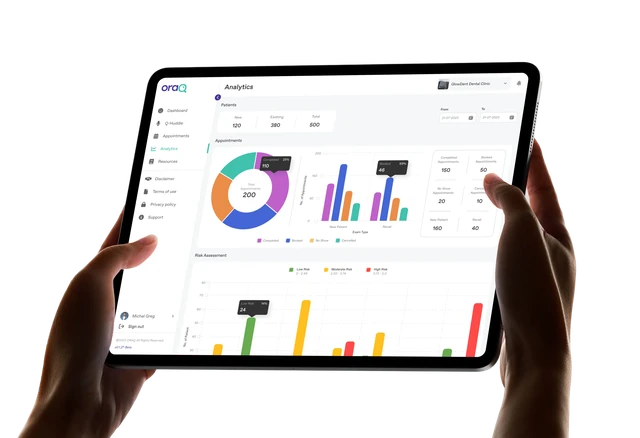
MindInventory built OraQ AI’s risk-scoring and treatment presentation layer to turn examination findings into a clear, evidence-backed risk picture so that dentists can discuss with patients. This helped address revenue loss at the treatment decision stage.

Outcomes:

Case acceptance lifted from 30–40% to 70%, against an industry norm of 30–40%
$250 to $330 of additional identified treatment per examination
Deployed across five practice management systems
Read Case Study

ArrowHQ - Modernized Claim Denial Management With AI-Powered RCM

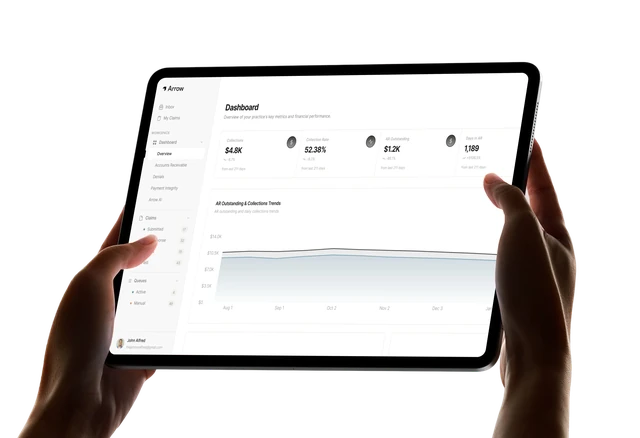
MindInventory developed ArrowHQ, an AI-powered RCM platform built to identify, resolve, and track claim denials. It connects EHRs, clearinghouses, and payer portals through a six-step workflow, with human billers reviewing and approving every claim action.

Outcomes:

85% reduction in claim denials, against a 30–40% benchmark for AI-driven RCM platforms
A/R days cut from 45 to 18
1.5B+ claims processed, across 100K+ clinicians
Read the ArrowHQ case study

Sully.ai - AI Medical Coding Agent That Improves Claim Readiness

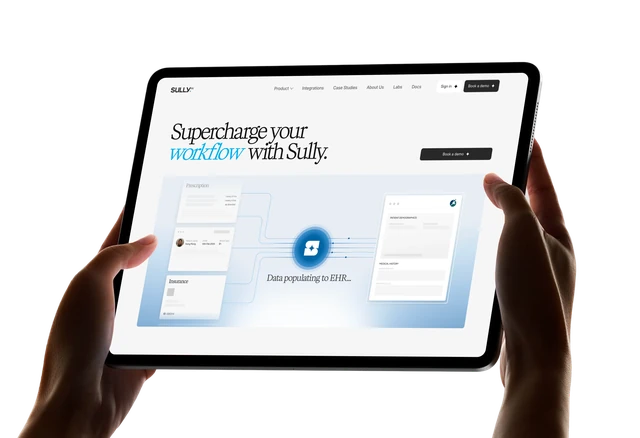
We engineered Sully.ai’s medical coding agent to map clinical documentation to billing codes and present them for coder confirmation. After, we Integrated with Epic and athenahealth, it improved documentation and coding quality before claims enter the billing workflow.

Outcomes:

12.5M+ minutes of clinical documentation automated
Used across 100+ healthcare organizations and 30,000+ providers
21x return on agent spend
Read Case Study

Looking to Solve a Complex RCM Challenge?

From denial management and medical coding to claims automation and revenue optimization, we build AI-powered RCM solutions around your workflows, systems, and business requirements. 

Healthcare specialist reviewing medical data

Choose the Right RCM Approach for Your Business

RCM platforms charge a share of what you collect: 2–4% for technology-only, 4–7% for full outsourcing. At $200M in annual collections that is $4M to $14M a year, indefinitely, and the fee grows as your collections grow. A custom build runs $200,000 to $600,000 once.

Build With Us

Build With Us

when your RCM challenges are specific to your specialty, workflows, or denial patterns. We helps you design and develop custom RCM software, integrate EHRs and payer systems, automate workflows, and build AI-powered capabilities around your existing operations.

Extend What You Already Have

Extend What You Already Have

when replacing your current RCM platform doesn’t make sense. We can build the missing capabilities, such as denial management, claims automation, coding, payment workflows, analytics, or integrations, around your existing systems.

Start With Your Data

Start With Your Data

by analyzing your historical denial and revenue-cycle patterns. This helps identify where technology can create the most value before you commit to a larger RCM development initiative.

Our Approach to Revenue Cycle Management Software Development

Step 1

Paperwork First

We put the necessary agreements in place, including BAA and NDA, before working with any claims or other sensitive healthcare data.
Step 2

Discovery

At discovery, we first analyze denial patterns, review your existing systems, and understand how your teams work. This allows to make right approach.
Step 3

Build With Your RCM Team

In this process, the development cycles and involve billers and revenue-cycle teams collaborate throughout the process to build right workflow.
Step 4

Roll Out in Controlled Stages

Our team start with one payer, specialty, or workflow, measure the results, and refine the solution before expanding. This helps to manage risk and give proper solution.
Step 5

Model Maintenance and Payer Rule Updates

Payer rules, workflows, and requirements keep changing. We support ongoing monitoring, model improvements, and updates to you RCM solutions.

How Much Does It Cost to Build an Custom RCM Software?

Engagement
Typical Cost
Typical Timeline
Best Suited For
Typical Scope
Denial pattern analysis on your own data
$15,000–$40,000
4–8 weeks
Providers or RCM teams validating AI opportunities
Historical claims analysis, denial patterns, root-cause identification, reporting
Focused AI module — denials, prior auth, or underpayment detection
$90,000–$180,000
5–8 months
Organizations targeting one high-impact RCM workflow
AI models, workflow automation, integrations, dashboards, testing
Full RCM platform with AI across the cycle
$200,000–$600,000
9–18 months
Healthcare organizations needing an end-to-end platform
Patient access, eligibility, coding, claims, denials, payments, analytics, AI
Specialty-specific AI on an existing platform
Scoped per engagement
4–8 months
Organizations with an existing RCM system
Specialty workflows, AI models, API/EHR integration, customization
RCM platform modernization & integration
$75,000–$250,000+
4–10 months
Organizations extending legacy RCM systems
API development, EHR integration, workflow modernization, data migration
AI-powered RCM optimization
$50,000–$150,000+
3–6 months
Teams improving an existing RCM operation
Denial prediction, automation, analytics, workflow optimization

Build the Next-Gen or Modernize Your RCM Software? 

From new RCM platforms to individual capabilities like denial management, prior authorization, and underpayment detection, we help you design, build, and scale the right solution around your workflows. 

Healthcare specialist reviewing medical data

Choose the Right RCM Development Model

Most of our revenue cycle clients are SaaS or BPaaS companies already building. The question is how to add people who know the domain.

Dedicated Team Inside Yours

Delivered Workstream

You get

Named engineers you interview and approve, working in your repos, your sprints, your tooling

A defined scope we own end to end, with our own PM and delivery accountability

Best when

You have product direction and roadmap ownership and need domain capacity you cannot hire fast enough

Need a denial engine, prior authorization workflow, or underpayment detector delivered by a specific date, without pulling your team away from its roadmap

Who runs it

Your leads. Our engineers report into your structure

Our project manager, reporting to your product owner

Ramp

Days on domain, not months. They arrive knowing X12 and payer behaviour

Discovery in weeks. We are not learning the domain on your time

Commercial shape

Monthly per engineer

Fixed scope or time and materials

Continuity

Teams stay. Some of ours have been with the same client for years

Handover and documentation scoped in

How We Build Compliance Into Revenue Cycle Management Software

With claims, payments, and patient data moving through your RCM platform, security needs to be built into every workflow. Every RCM solution we build follows a HIPAA security approach, including secure data handling, audit trails, and access controls.

Governance Frameworks We Work To

NIST AI Risk Management Framework · ISO 42001 controls · EU AI Act risk classification for systems used in Europe · model cards and documented evaluation results for clinical governance review

X12 EDI for 837 claims
270/271 eligibility and 278 prior authorisation
HL7 v2 for clinical data
FHIR R4 for clinical data
ICD-10
ICD-10
CPT
CPT
NCCI edits and modifier logic
CARC and RARC denial reason codes
835 remittance
835 remittance
HCPCS
HCPCS

Why Choose MindInventory

15+
Years in software development,

building secure healthcare platforms since our healthcare practice began.

ISO Certified

ISO 9001:2015 and ISO 27001:2013 certified for quality management and information security.

150+
Healthcare platforms

delivered across providers, startups, and enterprises globally.

Full compliance expertise in HIPAA, HL7, FHIR, GDPR, and FDA-ready development.
99% uptime for critical clinical systems and 70% reduction in clinical documentation time on delivered projects.
1,800+ global clients, including Fortune 500 companies, across the USA, UK, Europe, and the Middle East.
No domain ramp-up, our engineers bring hands-on knowledge of X12, CARC/RARC codes, payer rules, denials, and appeals from day one.
Proven RCM expertise across claims, denials, medical coding, prior authorization, payments, and revenue optimization workflows.

Epic and athenahealth integrations delivered in production, connecting clinical, billing, and revenue cycle workflows.
100% solution ownership with source code, models, integrations, payer logic, and documentation transferred to you on delivery.

Technology Stack We Use to Build RCM Software

Claims and EDI

X12 837
835
270/271
276/277
278

EHR and Practice Management

Epic
Oracle Health (Cerner)
athenahealth
MEDITECH
NextGen
Allscripts
Dentrix
OpenDental

Clearinghouses and payer Connectivity

Clearinghouse APIs
payer portals
eligibility services

AI and ML

OpenAI
Amazon Bedrock
Google Vertex AI
LangChain
LangGraph
PyTorch
scikit-learn
spaCy

Retrieval and Queuing

Pinecone
pgvector
SQS

Interoperability

HL7 v2
FHIR R4/R5
CCDA

Back-end

Python
Node.js
PHP
Golang

Cloud

AWS
Microsoft Azure
Google Cloud Platform
under BAA-covered configurations

Data and Analytics

Snowflake
Redshift
Azure Synapse
Databricks

FREQUENTLY ASKED QUESTIONS

Our RCM engineers get familiar with your codebase from day one. They already understand the revenue cycle vocabulary, payer behaviour and failure modes, so you don’t have to spend a quarter getting a general engineering team up to speed. You are buying the elimination of that quarter.
At MindInventory, denial pattern analysis starts using your own data typically costs $15,000 to $40,000. A focused module covering denials, prior authorisation or underpayment detection runs $90,000 to $180,000. A full RCM platform with AI across the revenue cycle runs $200,000 to $600,000 over nine to eighteen months. Compare that against platform pricing, which is typically charged as a percentage of collections rather than a fixed fee.


Yes. We can modernize or extend your existing RCM platform without replacing the systems that already work. We add new capabilities such as AI automation, denial management, analytics, payment workflows, and EHR integrations to improve and secure overall platforms.

RCM software should cover the revenue cycle from patient access and eligibility to claims, payments, and reporting. At MindInventory, we build features for denial management, prior authorization, AI-assisted coding, underpayment detection, claims automation, patient payments, EHR and PMS integrations, and analytics. These capabilities are tailored to your workflows, payer requirements, specialty, and existing healthcare systems.

Published industry figures for AI-driven RCM platforms cluster around 30% to 40% denial reduction, with the largest vendor reporting 40%. The platform we built for ArrowHQ achieved 85%, and the reason is specificity: it learned from that client’s own denial history rather than a national claims average. Expect benchmark results from a benchmark platform, and expect to beat it only where your denial patterns are distinctive enough to justify a model of your own.

Buy if you need broad payer connectivity, national benchmarking data and something running this year. The large platforms’ payer networks are a genuine advantage and expensive to replicate. Build if your specialty denial patterns are where the money is leaking, if you are an RCM or billing company whose platform is the product you sell, or if the revenue share has grown past what building and running your own would cost.

Behavioural health, oncology, specialty surgery, multi-state telehealth and risk-bearing arrangements, broadly speaking. These have billing rules, authorisation chains and denial patterns that differ substantially from general acute and ambulatory claims, and platforms trained mostly on the latter produce confident predictions that miss. This is where custom RCM work consistently outperforms.

You rent it. Payer connectivity is a commodity: clearinghouses such as Availity, Change and Office Ally sell claim submission, remittance, eligibility and prior authorisation transactions, several with free or low-cost core tiers. What you build on top is the payer-specific rule logic and the denial intelligence, which is where a generic platform underperforms on specialty patterns. The one thing you genuinely give up is the national benchmarking dataset that large platforms use to train predictions, and that matters for common cross-payer denial patterns rather than specialty-specific ones.

Yes, we help you integrate RCM with you EHR and clearinghouse. The evidence needed to work a denial sits across the EHR, the practice management system, the clearinghouse and the payer portal. We build as a connectivity layer over what you already run rather than replacing any of it.

At MindInventory, commercial RCM platform implementations commonly run six to twelve months. A focused custom module reaches production in five to eight months, and a full platform in nine to eighteen. The comparison is closer than people expect, because a large platform still requires payer configuration, workflow design and integration work at your end.

AI can improve RCM by identifying denial patterns, predicting claim risks, assisting with medical coding, automating prior authorization, detecting underpayments, and prioritizing recovery opportunities. We build AI-powered RCM solutions that integrate with EHRs, payer systems, and existing workflows to allow teams to review and approving critical revenue cycle decisions.

It can. More complete documentation supports higher evaluation and management levels, and national claims analysis has shown codes shifting upward after AI adoption, with payers responding by auto-reviewing higher-level claims. A coding system needs documentation that defends each code, clinician or coder confirmation of every suggestion, and a full audit trail of drafts and edits. Built that way it is an asset. Built without those controls it books revenue and accrues liability at the same time.

Yes. We works with both RCM and billing companies and healthcare providers. We help to build custom solutions for claims, denial management, coding, prior authorization, payment workflows, analytics, and integrations into existing systems and as per business requirements.

Healthcare Insights From Our Engineering Team

Written by the people doing the work, for the questions that come up before a project starts.
global ai in healthcare report

Global AI in Healthcare Report 2026

This report showcases data from Precedence Research, Grand View Research, Markets and Markets, McKinsey, Doximity, and others prominent research agencies. A comprehensive view provides builders, investors, and healthcare leaders a single, reliable picture of…

post
software development lifecycle phases

Software Development Life Cycle (SDLC): Phases, Types and Benefits

Maximizing efficiency in the software development process is what most business leaders seek, which is why over 94% of organizations practice Agile. Adopting a systematic development approach like a software…

post
top 17 software development trends

Top 17 Software Development Trends in 2026 Businesses Should Know 

Innovation in technology evolves at lightning speed.  Just a decade ago, 4G was making its debut, augmented and virtual reality (AR/VR) were confined to gaming and entertainment, and AI was primarily used…

post

Technology Partnerships That Strengthen Delivery

You Already Know What to Build. We Know the Domain. 

Most revenue cycle companies we work with have the product vision and the customers, and a hiring problem for engineers who understand claims. Tell us which roles or which workstream is missing and we'll tell you how fast we can fill it.

Healthcare specialist reviewing medical data