Custom Healthcare Software Development Services
Hipaa-Compliant Healthcare Software Built Around Your Clinical Workflows.
MindInventory provides custom healthcare software development services for clinicians, hospitals, payers, and healthtech companies. We engineer secure, HIPAA Compliant Software Development services and solutions tailored to your clinical workflows, operational needs, and integration requirements. With 50+ healthcare platforms delivered end to end and 126 healthtech domain experts across engineering, compliance, and clinical workflow design, we bring deep healthcare expertise to every project. Our experience includes the AI clinical workforce behind Sully.ai and the dental risk platform behind OraQ.


Trusted by Global Healthcare Services Providers, Medical Device Manufacturers, and Clinicians


50+
Healthcare Platforms Delivered End-to-End
126
Healthtech Domain Experts, Across Engineering, Compliance, and Clinical Workflows
15+ YEARS
Of Software Engineering Expertise
Security, quality and AI certifications






Solutions Built Around Your Healthcare Needs
Hospitals, Health Systems and Clinics
Your hospital’s existing systems are essential to daily operations. We build custom healthcare software that integrates with your existing infrastructure, supporting clinical workflows without disrupting care delivery.
Solutions we build
- Clinical workflow applications and EHR integrations
- Hospital and practice management modules
- Patient flow and capacity management systems
- Staff and caregiver scheduling solutions
- Clinical dashboards and department-specific applications
Payers, RCM and Medical Billing
Looking to streamline claims and reduce denials?
MindInventory provides medical software development services to help payers, RCM teams, and medical billing companies automate complex workflows and improve operational efficiency through seamless integration with clearinghouses, payer portals, and EHR systems.
Solutions we build
- Claims and denial management systems
- Eligibility and prior authorization automation
- Medical coding assistance
- Appeals management workflows
- Accounts receivable analytics
- Member and provider portals
Healthtech, Digital Health and SaaS
MindInventory helps healthtech and digital health companies build secure, scalable healthcare software from MVPs to enterprise-ready products. Our healthcare IT consulting services help you navigate healthcare regulations, clinical validation requirements, and architecture decisions that support product growth and technical due diligence.
Solutions we build
- Multi-tenant healthcare SaaS platforms
- AI-powered healthcare products requiring clinical validation
- EHR-integrated applications
- Software as a Medical Device (SaMD) products
- Wearable and medical device data platforms
- Healthcare MVPs and scalable product architectures
Medical Devices and Diagnostics
Building medical device software that meets regulatory requirements?
MindInventory develops custom medical device and diagnostics software aligning architecture with regulatory classification and applicable standards from the start. Our engineering approach incorporates ISO 13485 quality management, IEC 62304 software lifecycle processes, and ISO 14971 risk management to support regulatory preparation.
Solutions we build
- Medical device companion applications
- Cloud platforms for device data
- Biosensor and raw signal processing pipelines
- Clinician dashboards
- Software as a Medical Device (SaMD) solutions aligned with applicable classification pathways



Hospitals, Health Systems and Clinics
Your hospital’s existing systems are essential to daily operations. We build custom healthcare software that integrates with your existing infrastructure, supporting clinical workflows without disrupting care delivery.
Solutions we build
- Clinical workflow applications and EHR integrations
- Hospital and practice management modules
- Patient flow and capacity management systems
- Staff and caregiver scheduling solutions
- Clinical dashboards and department-specific applications
Payers, RCM and Medical Billing
Looking to streamline claims and reduce denials?
MindInventory provides medical software development services to help payers, RCM teams, and medical billing companies automate complex workflows and improve operational efficiency through seamless integration with clearinghouses, payer portals, and EHR systems.
Solutions we build
- Claims and denial management systems
- Eligibility and prior authorization automation
- Medical coding assistance
- Appeals management workflows
- Accounts receivable analytics
- Member and provider portals
Healthtech, Digital Health and SaaS
MindInventory helps healthtech and digital health companies build secure, scalable healthcare software from MVPs to enterprise-ready products. Our healthcare IT consulting services help you navigate healthcare regulations, clinical validation requirements, and architecture decisions that support product growth and technical due diligence.
Solutions we build
- Multi-tenant healthcare SaaS platforms
- AI-powered healthcare products requiring clinical validation
- EHR-integrated applications
- Software as a Medical Device (SaMD) products
- Wearable and medical device data platforms
- Healthcare MVPs and scalable product architectures
Medical Devices and Diagnostics
Building medical device software that meets regulatory requirements?
MindInventory develops custom medical device and diagnostics software aligning architecture with regulatory classification and applicable standards from the start. Our engineering approach incorporates ISO 13485 quality management, IEC 62304 software lifecycle processes, and ISO 14971 risk management to support regulatory preparation.
Solutions we build
- Medical device companion applications
- Cloud platforms for device data
- Biosensor and raw signal processing pipelines
- Clinician dashboards
- Software as a Medical Device (SaMD) solutions aligned with applicable classification pathways
Explore Our Healthcare Software Development Capabilities

Clinical and Care Delivery
-
 EHR/EMR systems
-
Telehealth and virtual care platforms
-
Remote patient monitoring
-
Clinical decision support and AI diagnostics
-
AI medical scribe and clinical documentation
-
Patient portals
-
Healthcare chatbots and conversational AI
-
Care and chronic disease management

Administrative and Operations
-
Hospital management systems
-
Revenue cycle management
-
Patient flow and scheduling
-
Staff and caregiver scheduling
-
Healthcare data analytics

Specialty
-
Medicare Advantage and payer platforms
-
Health insurance claims software
-
Medical device and SaMD software
-
Mental and behavioural health platforms
-
Medical imaging, PACS and RIS
Healthcare Areas We’ve Built For


Dental and oral health

Behavioral and mental health

Cardiology

Chronic care management

Diagnostics and laboratory

Radiology and imaging

Revenue cycle and medical billing

Health insurance and claims

Remote monitoring and wearables

Pharmacy and e-prescribing

Clinical research

Senior living and long-term care

Home healthcare

Fitness and wellness
These Results Make MindInventory a Trusted Healthcare Software Development Partner
Every project below is a production system with a named client, and the numbers come from after launch, not from a pilot. Most are still running, and several have been with us for years.

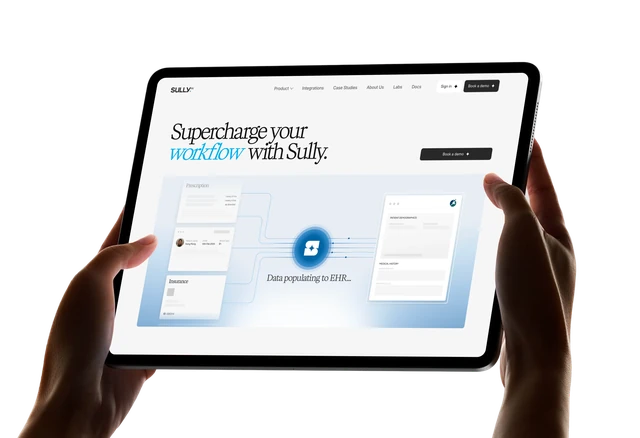
Sully.ai - Multi-agent Clinical AI and EHR Integration
MindInventory engineered Sully.ai, a multi-agent clinical AI platform for healthcare organisations, with six purpose-built agents covering reception, triage, scribing, clinical consultation, medical coding, and care coordination. The platform’s EHR integrations with Epic and athenahealth drew on capabilities relevant to EHR development services. Each agent ran in an isolated Docker environment beneath an orchestration layer that routed tasks between them, while every clinical output went through human review before reaching a patient record.
Outcomes:
12.5M+ minutes of clinical documentation automated
21x return on agent spend
Used across 100+ healthcare organisations and 30,000+ providers

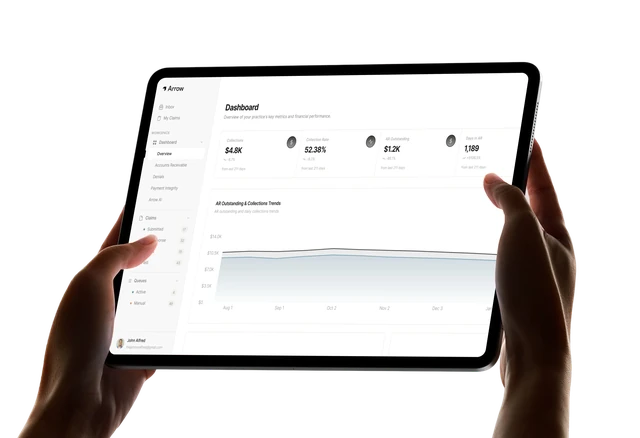
ArrowHQ - AI-powered RCM Denial Automation
MindInventory developed ArrowHQ, a HIPAA-aware, AI-powered revenue cycle management platform that helped healthcare providers manage claim denials through a six-step workflow: ingest, diagnose, prepare, review, act, and track. The platform integrated disconnected EHRs, clearinghouses, and payer portals, using Pinecone vector search and SQS queuing to support denial analysis and resolution, with human billers reviewing and approving every claim action.
Outcomes:
85% reduction in claim denials
A/R days cut from 45 to 18
1.5B+ claims processed

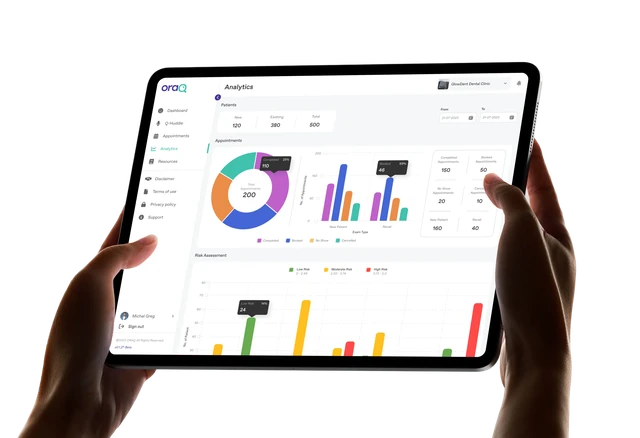
OraQ AI - AI-Powered Dental Diagnostics and Assessment
MindInventory engineered OraQ AI, an AI-powered dental assessment platform for dentists and dental practices that integrated patient history, dental imaging, and clinical findings to support consistent, risk-based dental examinations. The platform incorporated AI-powered risk-scoring models, a digital odontogram, periodontal charting, and practice management integrations, built on a compliance-ready architecture designed to support FDA and Health Canada clearance.
Outcomes:
Case acceptance lifted from 30–40% to 70%
Integrates with Dentrix, OpenDental, ClearDent, Curve, and Eaglesoft
$2.6M CAD seed round led by AngelMD; research partnership with the University of the Pacific's Dugoni School of Dentistry

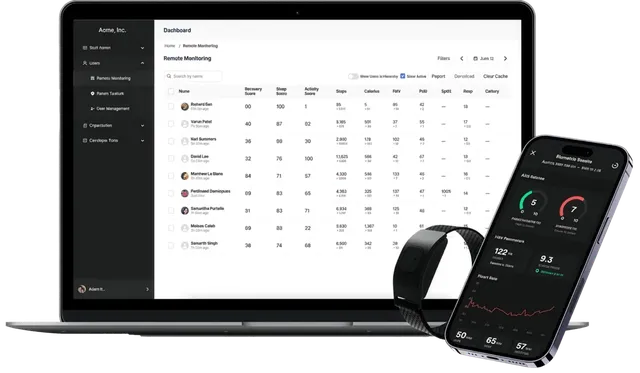
BioStrap - Clinical Wearable Health Platform
MindInventory developed BioStrap's mobile app, cloud biosignal pipeline, and HIPAA-compliant dashboard to support clinical research and wearable health monitoring. The platform preserves raw PPG, accelerometer, and gyroscope data from capture through cloud processing, enabling researchers and clinicians to work with physiological data beyond preprocessed summaries.
Outcomes:
Used across 100 clinical studies
Adopted by Stanford, UCLA, NASA, Pfizer, Tulane, CHLA, and the NIH
Independently validated against ECG (gold standard) references
You’ve Seen How We Help Healthcare Organizations Turn Complex Challenges into Measurable Outcomes
From automating 12.5M+ minutes of clinical documentation to reducing claim denials by 85%, our healthcare software engineering delivers measurable impact beyond code.

Our Proven Approach to Healthcare Software Development
Step 1
Paperwork First
BAA and NDA signed before we see PHI, sample data or production systems.
Step 2
Regulatory Discovery and Clinical Risk Framing
Before a wireframe, we settle what the software is from a regulatory standpoint: SaMD or not, risk class, and which standards govern. In parallel we map how clinicians actually work, and we make live contact with every system you’ll integrate with. Legacy EHRs rarely behave the way their documentation claims. Finding that out in week two costs a conversation. Finding out in month five costs the timeline.
Step 3
Compliance-first Architecture and Iterative Build
Encryption, access controls, audit logging and HL7/FHIR interoperability designed against the regulatory profile from day one. Two-week cycles, each reviewed by your clinical and compliance stakeholders. We schedule those reviews at 7am or after evening clinic, because a review a clinician can’t attend tells you nothing.
Step 4
Real-World Clinical and Interoperability Validation
Every workflow tested with actual clinical staff, and every data exchange tested against live external systems. QA proves the software runs. Only a nurse with six patients waiting proves it runs at clinical pace.
Step 5
Security Verification and Hypercare Go-Live
Penetration testing, access-control verification and audit-log validation, then a staged rollout with extra support through the first one to two weeks, when issue volume peaks.
Step 6
Audit-Ready Documentation and Post-Launch Surveillance
Risk files, validation records and architecture documentation delivered as verifiable evidence. For SaMD and other regulated builds, real-world performance monitoring continues as a formal obligation, because a silent failure in a clinical system becomes a patient-safety event before anyone files a ticket.
How We Connect Custom Healthcare Software with Your Existing Systems
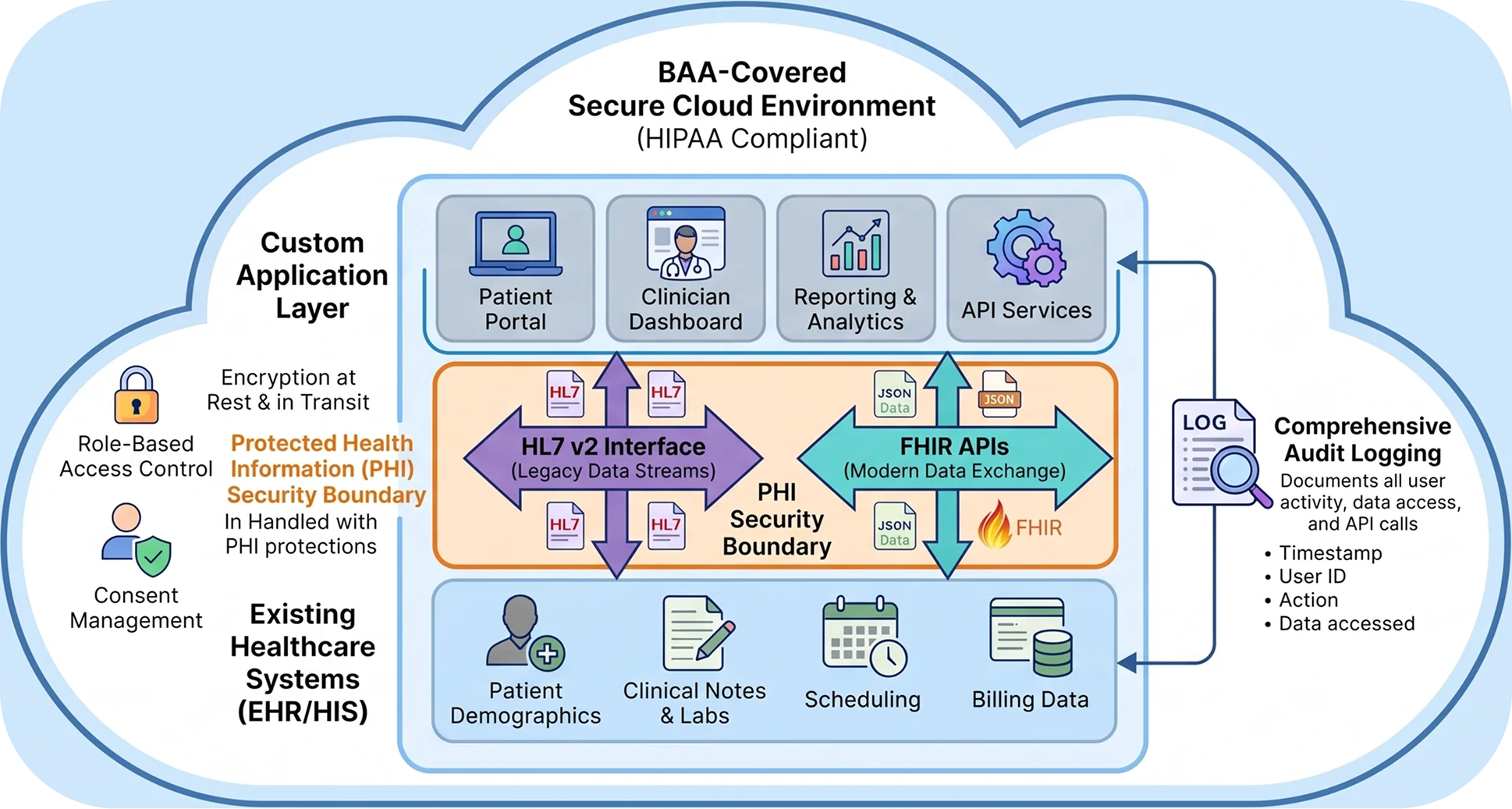
A connected healthcare ecosystem, designed around your existing infrastructure, with secure data exchange, clear PHI boundaries, and audit logging.
Not Sure Whether to Build, Integrate, or Improve Your Healthcare Software?

Compliance and Ownership
Compliance Built into the Way We Work
MindInventory brings quality, security, and regulatory considerations into your healthcare software journey from the start whether you're building a clinical application, scaling a healthtech product, or developing medical device software. Our certified expertise helps you navigate complex requirements with confidence, so you can focus on solutions that work for your clinicians, patients, and business.

Medical device quality management, required for most SaMD work
Healthcare security and privacy, the framework US health systems assess vendors against
Security and confidentiality controls, audited over months rather than a single date
Information security management

AI management systems, still rare among development partners
Quality management
At MindInventory, we bring ISO 13485 and HITRUST together to support healthcare clients with both medical-device quality and healthcare security requirements. This combination is uncommon among healthcare technology development partners and can help health systems assess our practices during vendor onboarding. It may also reduce the need to establish those capabilities internally. Each health system still conducts its own vendor and security review, so these credentials do not guarantee or replace approval.
Standards and Requirements We Build To
Our teams account for the standards and requirements relevant to each project, based on its intended use, markets, data, and regulatory classification.












What You Own
To make ownership clear, here's what transfers to you:
The Code
All of it, on delivery, assigned to you outright.
The AI Assets
Model weights, training pipelines, prompt architecture and evaluation sets transfer with the code. We keep no reusable components from your build.
The Documentation
Architecture records, risk files, validation records and audit-ready compliance documentation.
The Exit
Knowledge transfer to your in-house team or another vendor is scoped into the engagement. Your system runs without any licence from us.
Eight Questions to Ask Any Healthcare Development Partner
Ask
Weak Answer
Ours
What healthcare systems have you actually shipped?
A logo slide and one medical app among unrelated projects
50+ healthcare platforms end to end. Named clients you can look up: Sully.ai, OraQ, ArrowHQ, Biped AI, BioStrap
How many BAAs have you executed, and is yours standard or negotiated?
"We can sign one"
A standard BAA executed before any PHI access, on every applicable engagement
Which EHRs have you integrated with in production?
"We support HL7 and FHIR"
Epic, Oracle Health (Cerner), athenahealth, MEDITECH, plus five dental practice management platforms in live production
Which certifications do you hold, and can we see the reports?
"We follow HIPAA best practices"
ISO 13485, HITRUST, SOC 2 Type II, ISO 27001, ISO 42001, ISO 9001 — certificates and scope statements provided on request
Who validates the clinical workflow before go-live?
QA engineers running test scripts
Actual clinical and administrative staff, testing every workflow at real pace, before launch
Who owns the code, the models, and the documentation?
Ownership discussed at project close
Assigned to you in the service agreement. Code, model weights, pipelines, and docs. We keep no retained components
Will the team that starts still be there in month nine?
"We’ll assign our best available people"
A named team you interview and approve. Our OraQ team has run since 2022
Can we speak to a reference about the hardest six months?
A curated quote
Direct reference calls arranged on request
One more worth knowing
A quote that lands 40% under every other bid usually means one of three things:
- Scope you haven't noticed has been cut
- Compliance work has been left out
- The margin will return as change requests
In healthcare, the compliance work is the part that can't be skipped.
What Does Healthcare Software Development Cost?
Project Type
Typical Cost
Typical Timeline
Prototype / PoC
$15,000 – $40,000
4 – 8 weeks
Focused app or MVP
$50,000 – $90,000
3 – 4 months
Mid-complexity platform with EHR integration
$90,000 – $180,000
5 – 8 months
Enterprise platform, multi-role, full HIPAA architecture
$180,000 – $250,000+
9 – 12+ months
SaMD / regulated device software
$200,000+
12+ months including clearance
Cost Drivers, in Order of Impact
Our estimates account for compliance review cycles and clinical validation time upfront rather than surfacing them as a month-six change request. When a requirement shifts mid-project, we assess the compliance impact alongside cost and schedule, because in healthcare those are three different things.
Need a Clearer Picture of Your Project’s Cost and Timeline?
Send us the outline and we'll come back within 24 hours with an indicative cost, an indicative timeline, and what we'd need to firm both up.

Flexible Engagement Models for Your Healthcare Software Project
Choose an engagement model for MindInventory’s custom healthcare software development services that fits your project scope, timeline, and the level of control your team wants.
Best for
You control
We control
Staff Augmentation
-
Ongoing platform work

-
Long-horizon roadmaps
-
Priorities
-
Sprint direction
-
Team composition
-
Recruiting
-
Retention
-
Technical standards
Time & Material
-
Evolving scope
-
Discovery-led builds
-
Integration work
-
Scope changes without renegotiation
-
Delivery velocity
-
Staffing
Fixed Cost
-
Defined scope
-
MVPs
-
Regulatory-bounded builds
-
Budget certainty upfront
-
Scope delivery within agreed cost
Staff Augmentation
Best for
-
Ongoing platform work
-
Long-horizon roadmaps
You control
-
Priorities
-
Sprint direction
-
Team composition
We control
-
Recruiting
-
Retention
-
Technical standards
Time & Material
Best for
-
Evolving scope
-
Discovery-led builds
-
Integration work
You control
-
Scope changes without renegotiation
We control
-
Delivery velocity
-
Staffing
Fixed Cost
Best for
-
Defined scope
-
MVPs
-
Regulatory-bounded builds
You control
-
Budget certainty upfront
We control
-
Scope delivery within agreed cost
Who You Actually Work With
Where a build touches AI, our AI and data practice joins the same team under the same project manager, so you coordinate one engagement rather than two.

How We Work with Teams in the US, UK and EU
Built Around Your Working Hours
MindInventory teams work with your business hours in mind, with planned daily overlap of few hours for collaboration across the US, UK, and EU. Stand-ups, clinical reviews, and stakeholder sessions can take place during your working day helping your team stay connected without relying on end-of-day handovers.
Single Point of Contact
A single project manager with regulated healthcare delivery experience, accountable for the engagement and reachable directly. You meet and approve the engineers before kickoff.
Distributed team, single controlled environment
Engineers work inside access-controlled environments provisioned for your engagement, never on local machines holding production data. Access is granted per named individual and revoked on rotation. Distributed delivery does not mean distributed PHI.
Why MindInventory

Verifiable, not anonymous
We make our healthcare case studies transparent. Every client featured on this page is named, so you can explore how our software development services for healthcare supported their projects and review the outcomes for yourself.

A domain team, not a general team with a healthcare deck
126 experts working only on healthcare engagements, never shared across unrelated industries. Healthcare software fails most often when it's built by people fluent in code and illiterate in clinical context.

Procurement-ready on day one
ISO 13485 and HITRUST together mean a health system can onboard us without a six-month security review, and SaMD work can start under an existing certified QMS.

Advice That Puts Your Needs First
Custom software isn’t always the right solution. If configuring an existing platform better meets your needs, we’ll tell you during scoping. Our goal is to help you choose the right approach for your organization not to recommend a build you don’t need.
The Technologies Behind Our Healthcare Software
Struggling With a Complex Healthcare System or Workflow?
Bring us the challenge, and our healthcare engineering team will help you identify the right solution, effort, and next steps.

Frequently Asked Questions
Here’s a list of FAQs that will help you to know more about MindInventory.
Custom healthcare software development is the process of building software around specific clinical, administrative, or healthtech product workflows rather than relying on a packaged solution. At MindInventory, projects may involve requirements discovery, regulatory assessment, secure architecture, development, integration, clinical workflow validation, and post-launch support. Depending on the product, relevant considerations may include HIPAA safeguards, HL7/FHIR interoperability, or FDA SaMD requirements.
Custom healthcare software development typically ranges from $15,000 for a prototype or proof of concept to $250,000 or more for an enterprise platform. A focused healthcare app development services or MVP may cost $50,000–$90,000, while a mid-complexity platform with EHR integration may cost $90,000–$180,000. SaMD and regulated device software starts around $200,000. Costs depend on scope, integrations, security needs, and validation requirements.
A custom healthcare software project may take four weeks to 12 months or longer, depending on its scope and complexity. A prototype may take four to eight weeks, an MVP three to four months, and an enterprise platform nine to 12 months or more. SaMD timelines can extend beyond development to include regulatory activities; review and clearance timelines vary by pathway.
HIPAA applies to covered entities and their business associates when they handle protected health information in activities covered by the law. Whether a particular software project needs HIPAA-related safeguards depends on the organizations involved, the data, and how the software is used. MindInventory considers applicable privacy and security requirements during planning and architecture; compliance also depends on implementation and ongoing operations.
Choose an off-the-shelf product when it supports your workflows with minimal changes. Consider configuring an existing platform when its core capabilities fit and the gaps can be addressed through settings. Custom development may make sense when essential workflows, integrations, or product requirements cannot be met by available solutions. The decision should weigh fit, cost, implementation time, maintenance, and regulatory needs.
A poor fit can lead to extra customization, manual workarounds, integration challenges, or delayed adoption. Building custom software when an existing platform would meet the need can also add unnecessary cost and maintenance. Assessing workflows, integrations, security, and long-term ownership before choosing an approach can help identify these risks early.
Yes, custom software can integrate with an existing EHR when the required interfaces, vendor access, and technical capabilities are available. Integration may use HL7 v2, FHIR, or vendor-specific APIs. MindInventory assesses the target systems and workflows during discovery to identify integration requirements, dependencies, and potential constraints.
Intellectual property ownership is defined in the project agreement. It should specify the rights and deliverables that transfer to the client, including source code, project-specific AI assets, and documentation, as applicable. Pre-existing technology and third-party components may remain subject to separate licences. MindInventory can clarify ownership, licensing, and knowledge-transfer expectations before development begins.
Patient data should be accessed and handled according to applicable privacy, security, and contractual requirements. Where feasible, teams can use de-identified or synthetic data instead of production protected health information. Before work begins, clarify data access, authorized users, safeguards, retention, and deletion practices with your development partner. MindInventory can discuss these requirements during project planning.
A prototype or proof of concept can help validate a technical approach, core workflow, or key assumption before a larger investment. It is not necessary for every project; the right starting point depends on the scope and what needs to be tested. MindInventory’s typical prototype or PoC estimate is $15,000–$40,000 over four to eight weeks.
Ask which certifications the partner holds, what entities and services they cover, and whether they are current. Depending on the project, relevant credentials may include ISO 27001, SOC 2 Type II, HITRUST, ISO 13485, ISO 9001, or ISO 42001. No single certification establishes that every project is compliant. HIPAA itself is not a certification; ask how applicable HIPAA requirements are addressed in practice.
Yes. MindInventory works with healthcare companies in the US, UK, EU, Middle East, and Australia. Project requirements depend on where your organization operates, where patient data is handled, and the product’s intended use. We consider applicable privacy laws and medical-device regulations, such as GDPR or EU MDR, as part of project planning.
Healthcare Insights From Our Engineering Team
Written by the people doing the work, for the questions that come up before a project starts.

Global AI in Healthcare Report 2026
This report showcases data from Precedence Research, Grand View Research, Markets and Markets, McKinsey, Doximity, and others prominent research agencies. A comprehensive view provides builders, investors, and healthcare leaders a single, reliable picture of…
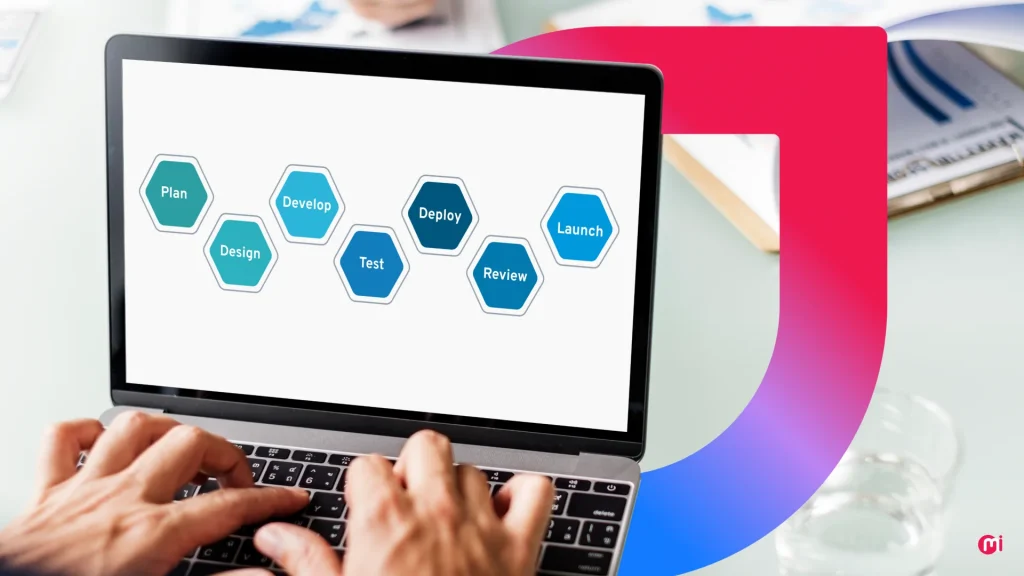
Software Development Life Cycle (SDLC): Phases, Types and Benefits
Maximizing efficiency in the software development process is what most business leaders seek, which is why over 94% of organizations practice Agile. Adopting a systematic development approach like a software…
Top 17 Software Development Trends in 2026 Businesses Should Know
Innovation in technology evolves at lightning speed. Just a decade ago, 4G was making its debut, augmented and virtual reality (AR/VR) were confined to gaming and entertainment, and AI was primarily used…