Hire Digital Twin Developers

Bring your digital twin vision to life with developers who understand more than 3D models. MindInventory helps you build a team for interactive digital replicas, real-time data connections, simulation, monitoring, and intelligent analysis. Whether you need one specialist or a multidisciplinary team, we align the skills with your assets, systems, and business goals.
15+ Years Experience
7+ Digital Twins Delivered
50+ Digital Twin Specialists
18+ Industries Served

Your Project. Our Experts. Let’s Begin

Tell us the roles and skills you need. We'll share matched profiles the same day, you interview the ones you like, and approved engineers start the following day.

ISO 27001
ISO 23247
AICPA SOC 2
HIPAA
ISO 9001:2015
GDPR

Get the Right Digital Twin Skills for Your Project

Hire digital twin developers from MindInventory to fill specific skill gaps or build a team around your project. We can help define technical roles, agree on deliverables, and establish a practical development workflow before implementation begins.
If you need to…
Build a team with…
Create a high-fidelity interactive twin
3D developers, Unreal Engine or Unity specialists, technical artists, simulation engineers
Connect a twin to real-world systems
IoT developers, data engineers, API integration specialists, cloud/edge engineers
Monitor assets and operating conditions
Digital twin developers, dashboard engineers, data visualization specialists, backend developers
Add predictive capabilities
AI/ML engineers, data scientists, developers experienced in model integration
Extend an existing platform
Platform specialists, integration engineers, QA, and DevOps support

Hire Digital Twin Developers with the Right Expertise
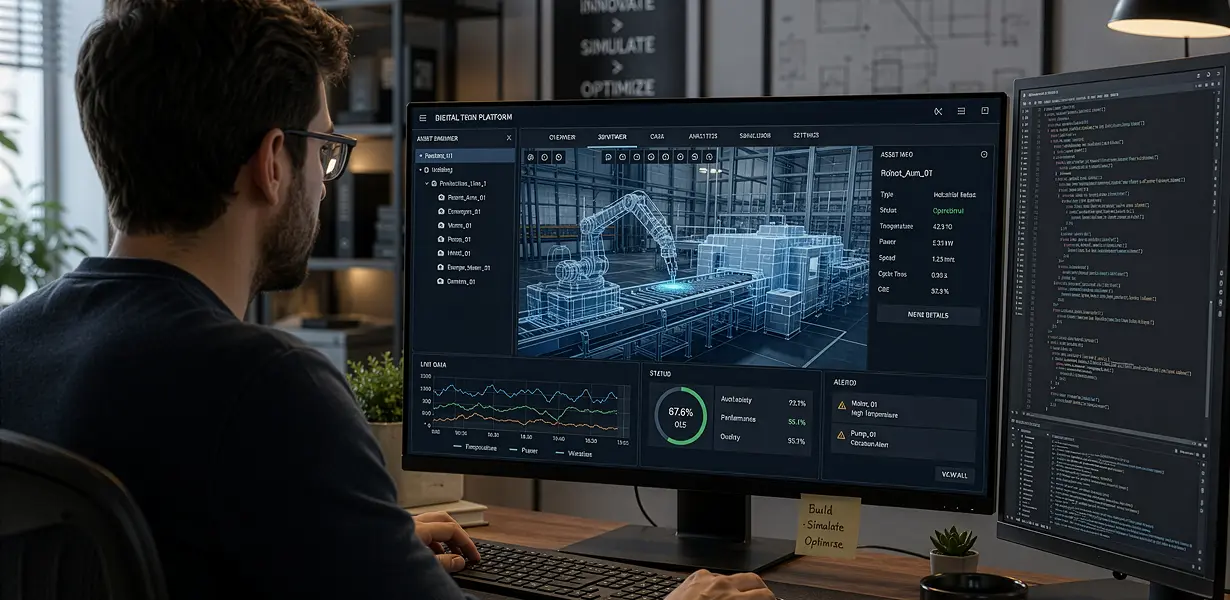
Build your digital twin with developers who understand your business goals and technical needs. Whether you need 3D modeling, real-time data integration, simulation, or connected systems, find the right expertise to turn your requirements into a working solution.
Modern collaborative workspace for digital twin development and simulation engineering

3D Digital Twin and Visualization Developers

Build interactive digital representations of equipment, products, facilities, and environments. Developers can work with 3D assets, scene composition, spatial data, user interactions, and visual interfaces to help users explore a twin and understand what is happening in the physical environment.

Unreal Engine and Unity Developers

Build immersive 3D environments, interactive simulations, and real-time visualizations for digital twin applications using the right tools for your project. Unreal Engine development services can help create high-fidelity visual experiences tailored to your simulation goals, target devices, performance needs, and existing technology stack.

IoT and Real-Time Data Integration Developers

Connect sensor readings, telemetry, and operational systems to the digital model. Depending on the environment, this can include data ingestion, event processing, APIs, gateways, message brokers, and validation that helps keep the twin’s state aligned with the physical asset.

Simulation and Digital Twin Logic Developers

Implement the rules, relationships, and behaviors that allow a twin to represent a real process. This may include what-if scenarios, process simulation, physics-based behavior, state changes, or links between assets and systems. Scope should reflect the decisions users need to make.

AI/ML and Predictive Analytics Engineers

Integrate forecasting, anomaly detection, condition monitoring, or optimization models where the use case justifies them. AI is not required for every digital twin; introduce it when data quality, business value, and operational workflows support it.

Backend, Cloud, and Platform Integration Developers

Develop APIs, data services, identity controls, storage, monitoring, and integrations that support the twin across environments. They can connect digital twin applications with existing enterprise platforms and plan for performance, security, and future growth.

QA, DevOps, and Performance Specialists

Test the twin across supported devices and data conditions, validate integrations, monitor performance, and improve deployment workflows. Testing for operationally important systems should cover stale data, missing readings, connection loss, access permissions, and recovery behavior.

What Our Digital Twin Developers Can Build

Our digital twin developers can help you build a new solution or improve an existing one. The work is tailored to your project goals, available data, chosen platforms, and business needs.
Solution Type
What the team can develop
Example uses
Asset digital twins
Digital representation, asset state, telemetry connections, alerts, maintenance views
Monitor equipment condition and asset performance
Production and process twins
Process models, workflow visualization, simulation, performance dashboards
Explore bottlenecks and evaluate production changes
Facility and infrastructure twins
3D environments, spatial data layers, building or infrastructure systems integration
Understand facility status and compare planning scenarios
Product digital twins
Product models connected to lifecycle, usage, or performance data
Explore product behavior and support maintenance or design decisions
Simulation-led twins
Interactive scenarios, behavior models, configurable parameters, result visualization
Test alternatives virtually before physical changes
AI-enabled twins
Predictive model integration, anomaly signals, forecasts, model monitoring workflows
Surface patterns that may require investigation or action
Flowing digital waves symbolizing digital twin data streams and telemetry

Have a specific asset, process, or platform in mind?

Tell us what you need your digital twin to do, and we’ll help define the skills and scope.

Industry Experience and Use Cases

Digital twin development is most useful when tied to a clear operational question. Our team can shape the implementation around the data, workflows, and constraints of your industry.

Manufacturing

Build twins of machines, production lines, or factory environments with manufacturing digital twin solutions to support equipment monitoring, process visualization, production simulation, and predictive maintenance workflows.

Healthcare

Develop digital representations for suitable healthcare use cases with healthcare digital twin solutions, supporting facility planning, equipment visibility, operational workflows, and simulation while addressing sensitive data handling, system integration, and applicable privacy and security requirements.

Energy and Utilities

Connect asset data and visual models to support infrastructure monitoring, performance analysis, maintenance planning, and scenario evaluation.

Construction and Real Estate

Combine 3D models, building information, and operational data to support facility visualization, building performance insights, and lifecycle management.

Transportation and Infrastructure

Develop spatial and operational views of infrastructure, fleets, or connected systems to support planning, monitoring, and scenario analysis.

Technology and Integration Capabilities

The right technology stack for a digital twin depends on what it needs to represent, how accurately it must reflect real-world conditions, and how it will be used. Factors such as real-time data processing, system integrations, deployment requirements, and your team’s technical expertise should guide the selection of tools and platforms.
Real-time 3D engines icon

Real-time 3D engines

Unreal Engine or Unity for interactive visualization, simulation, and immersive experiences where appropriate
3D and engineering data icon

3D and engineering data

Existing CAD, 3D assets, BIM, GIS, or other spatial and engineering data, subject to format and quality
IoT and connectivity icon

IoT and connectivity

Sensor and telemetry ingestion, gateways, message-based communication, device/system integrations
Data engineering icon

Data engineering

Data pipelines, normalization, storage, historical data, and data quality checks
AI/ML and analytics icon

AI/ML and analytics

Forecasting, anomaly detection, classification, optimization, and analytical insights where justified
Cloud and edge icon

Cloud and edge

Cloud-hosted services, edge processing, deployment, monitoring, and scaling based on latency and connectivity
Enterprise integrations icon

Enterprise integrations

APIs and connectors for operational, asset, maintenance, or enterprise systems

Engagement Models

Whether you need dedicated digital twin developers for a specific project, extra expertise to support your in-house team, or a complete team for long-term development, choose an engagement model that fits your project scope, timeline, and preferred level of control.
Engagement model
Best for
How it works
Dedicated Developer
A defined skill gap or development stream
A developer focuses on agreed tasks and collaborates through your preferred workflow.
Dedicated digital twin team
Projects needing 3D, data, integration, backend, and QA skills
A coordinated team works toward shared milestones, with roles matched to scope.
Team augmentation
Extending an existing product or twin platform
Specialists join your workflow, repositories, meetings, and delivery practices.
Project-based delivery
Defined scope and acceptance criteria
The team works against a scoped plan, milestones, and review points.
Dynamic futuristic gradient waves representing scalable digital twin team architectures

Not sure which setup fits your project?

Share your timeline, current stack, and required capabilities.

How to Onboard Digital Twin Developers

The goal is to get the right people working on the right problems, with scope and responsibilities clear from the start.

Define the use case

Discuss the asset, process, users, business goals, and what the twin needs to help them understand or decide.

Map the required skills

Identify the mix of 3D, simulation, IoT, data, AI/ML, backend, cloud, and QA skills the work needs.

Review the existing environment

Discuss available models, data sources, APIs, platforms, security requirements, and constraints.

Agree on scope and collaboration

Define roles, deliverables, communication, milestones, access, and acceptance criteria.

Start with a focused work plan

Begin with prioritized tasks, regular reviews, and a clear way to raise risks or dependencies.

Validate and improve

Test functionality, data behavior, performance, and user workflows, then plan the next iteration based on results.
Glowing digital waveforms symbolizing interactive digital twin models and simulations

Hire Digital Twin Developers to Bring Your Vision to Life

Tell us about your project, and we’ll help you find the right digital twin experts, skills, and engagement model.

Why Hire Digital Twin Developers from MindInventory?

Building a reliable digital twin requires more than creating a virtual model. MindInventory combines digital twin development with expertise in 3D engineering, Unreal Engine, IoT, AI/ML, data engineering, and cloud technologies to build solutions aligned with your project’s technical requirements and business goals.

Use-case-first development

Start with the operational question and success criteria, then select the appropriate technical approach.
Bring together 3D, simulation, data, IoT, backend, cloud, and QA expertise as needed.
Assess available data and integrations before deciding what must be built or connected.
Break work into reviewable milestones and validate assumptions early.
Plan for security, performance, maintainability, and future integration requirements.

A Trusted Technology Partner for Business Growth


15+
Years Experience
2700+
Projects Delivered
1800+
Clients Served
300+
In-house Tech Specialists
18+
Industries Served

ISO 9001 ISO 9001:2015
ISO 27001 ISO 27001:2022
SOC 2 Type II SOC 2 Type II
HIPAA Compliance HIPAA Compliance

What Our Clients Have to Say About MindInventory

Behind every testimonial is a business problem solved, a system improved, or a product successfully launched. Here is how our clients describe their experience working with MindInventory.
Quotation mark icon

MindInventory's developers are the best

Our business scaled faster with quicker onboarding and installation processes enabled by MindInventory. Their team demonstrated excellent project management skills, and we were particularly impressed with their developers. Communication was smooth and efficient through virtual meetings.


Play video icon
Dimas Lipiz

Dimas Lipiz

CEO, RouteMe

Quotation mark icon

We were impressed with their excellent project delivery.

The project was delivered on schedule, with additional resources provided at no extra cost. MindInventory ensured strong customer success follow-ups and maintained effective communication throughout. Their dedication and client-focused approach truly set them apart.

Prakash Senghani

Prakash Senghani

CEO, Navatech Group Limited

Quotation mark icon

Strong Collaboration on a Full Trading App

I have had the pleasure of working with MindInventory for more than a year now on our biggest design challenges of creating a full trading app for both web and mobile. From the very start, the collaboration was smooth and effective. The team really understood our vision, and they quickly aligned with our high standards. Together, we designed a platform that feels intuitive, reliable, and engaging for our users. I highly recommend MindInventory to anyone looking for strong design.

Play video icon
Bogdan Ungureanu

Bogdan Ungureanu

Head of UI UX, NAGA.com

Quotation mark icon

Turning a Dream App into Reality with Creativity and Strong Project Planning

A dream was turned into reality with an app that makes it easy for managers and colleagues to share meaningful appreciation at work. The MindInventory team truly listened, understood the vision, and provided flexibility, creativity, and unbeatable project planning. Within months, the app came to life and is now being used and loved.

Play video icon
Erika Migliaccio

Erika Migliaccio

CEO & Founder, Upstream HR

Quotation mark icon

We’re delighted to have them as our partners because they’re phenomenal.

Cost-effective services from MindInventory made it easier to scale the business efficiently. The team maintains a timely and communicative process using tools like Jira and Slack. Their reliability and ability to quickly find the right resources are highly appreciated.

Play video icon
Dmitiry Richard Starson

Dmitiry Richard Starson

CEO, Passio.ai

Frequently Asked Questions

Here, you’ll find answers to some of the most common questions about hiring software developers from MindInventory.

A digital twin developer builds or connects software components that represent a real-world asset, process, product, or environment. Depending on the project, this can include 3D models, data integrations, simulation logic, dashboards, APIs, and connections to IoT, AI/ML, or cloud systems.

Look for skills that match your use case. A visualization-heavy twin may need Unreal Engine or Unity and 3D expertise. A data-connected operational twin may also need IoT, data engineering, APIs, cloud or edge computing, and backend development. Simulation and predictive use cases may require additional domain, modeling, or AI/ML skills.

Yes. Unreal Engine can be used for real-time 3D visualization, interactive environments, and simulation-led digital twin experiences. The team should assess visual fidelity, data connections, target hardware, performance needs, and simulation behavior before confirming the architecture.

No. Some digital twins use periodic updates, historical data, engineering models, or simulated data. Real-time IoT integration is useful when the business case depends on current asset or process conditions. Update frequency should be based on the use case and operational requirements.

They can assess and develop integrations when suitable APIs, data access, protocols, and permissions are available. The plan depends on platforms involved, data quality, security requirements, and constraints in the current environment.

The timeline depends on scope, model complexity, number of assets, available data, integration work, simulation requirements, and validation needs. A focused proof of concept is smaller than a production-ready twin spanning multiple systems. A realistic estimate should follow technical discovery and scope review.

Cost depends on the number and seniority of developers, specialist skills, engagement duration, technology stack, and project complexity. Real-time integrations, high-fidelity 3D, simulation, security, and legacy-system connections can add effort. Share your requirements for a scope-based estimate.

Yes. Team augmentation can help when you already have a platform or internal team and need additional expertise in 3D development, Unreal Engine, data integration, simulation, AI/ML, cloud, or QA. Responsibilities and access should be agreed before onboarding.

Digital twins can support use cases in manufacturing, healthcare, energy and utilities, construction, real estate, transportation, and infrastructure. The value depends on whether a digital representation can improve visibility, simulation, planning, maintenance, or decisions for a specific asset or process.

Prepare a short description of the asset or process, the problem to solve, available data and systems, expected users, required platforms or hardware, and success measures. If some details are still open, a discovery discussion can help clarify them.

Hiring developers usually means adding individual specialists or a dedicated team to work with your organization. Project-based delivery is more suitable when you want a partner to take responsibility for a defined scope and deliverables. The best model depends on internal expertise, governance, and how you want to manage day-to-day delivery.
Other Talents You May Want to Hire

Explore more technological expertise to hire for your project and enhance your project team.

Key Insights From Our Digital Developers

Explore our featured technology insights on news boards that are popular among our readers.
benefits of synthetic data for ai
post

Benefits of Synthetic Data for AI and Business

Synthetic data helps businesses train AI models, test software, and develop data-driven products when real-world data is limited, expensive, difficult to access, or sensitive. It is artificially generated data designed…

post

How Data Science Can Drive Informed Decision-Making in Your Organization?

In this internet world where data is the biggest treasure any business can hold. This also makes it important to learn the effective ways data can be leveraged. Amongst many,…

post

How AI and ML in Business Processes Improve Business Operations 

Artificial intelligence (AI) and machine learning (ML) help businesses automate repetitive work, analyze operational data, predict outcomes, and make better decisions. When integrated into business processes, these technologies can improve…