Medicare Advantage & Payer Platform Development Services

Streamline Claims. Simplify Benefits. Improve Member Experiences.

MindInventory builds Medicare Advantage and payer platforms covering membership, billing, claims, payments, risk adjustment, HEDIS, quality analytics, utilization management, and care management. With FHIR-based data stores and integration architecture, we develop scalable solutions for health plans, MA technology companies, BPaaS firms, and risk-bearing provider groups.

Hire Healthcare Engineers

Tell us the roles and skills you need. We'll share matched profiles the same day, you interview the ones you like, and approved engineers start the following day.

Trusted by Global Healthcare Services Providers, Medical Device Manufacturers, and Clinicians
Sully.ai
Passio
OraQ
SensorBio
Claim Clarity
Shoorah
65+

Healthcare platforms delivered end to end

126

Healthtech domain experts

1.5B+

Claims processed across our payer and RCM builds

15+

Years in Industry

Our Expertise Across Medicare Advantage & Payer Platform Modules

Core Administration

The transactional spine. Where members, money and claims live.

  • Membership, enrolment and eligibility
  • Premium billing and reconciliation
  • Claims intake, adjudication support and payment
  • Member services workflows and case handling
  • Provider services, contracts and reimbursement
  • Encounter data submission, reconciliation and error resolution
  • X12 transaction processing: 834, 837, 835, 270, 271, 276, 277 and 278

Risk Adjustment and Quality

Where plan revenue is earned and defended.

  • HCC capture, suspect identification and coding workflow
  • AI-assisted chart review with clinician validation in the loop
  • HEDIS data pipelines and supplemental data management
  • Risk and quality analytics, cohort and gap reporting
  • In-home and virtual assessment scheduling and capture
  • Member and provider outreach sequencing, with documented attempts
  • Star Ratings measure instrumentation and intervention tracking
  • RADV audit response tooling and submission history reconstruction

Health Management

Where clinical decisions and member outcomes happen.

  • Utilisation management and prior authorisation workflows
  • Care management, care plans and interdisciplinary care teams
  • SNP model of care documentation and health risk assessments
  • Population segmentation, stratification and clinical insights
  • Clinical integration to EMR, laboratory and diagnostic sources
  • Case and disease management tooling

A FHIR data store, an integration architecture that doesn’t force every module into point-to-point connections, and role-based access, encryption and audit logging designed in rather than retrofitted.

Tell Us Which Modules You Are Missing

Payer Platforms We Have Engineered

Medicare Advantage Platform Engineering for a US Health Technology Company

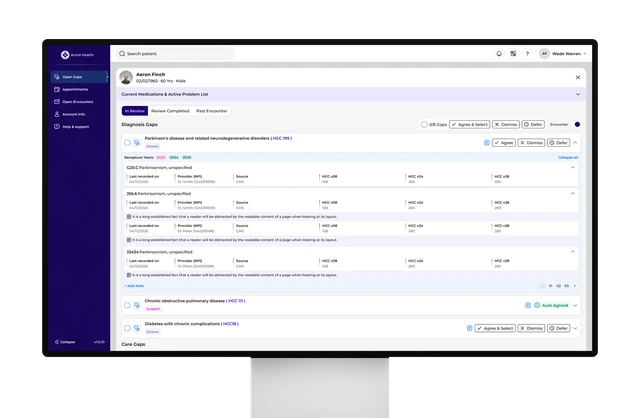
MindInventory engineered a Medicare Advantage platform for a US-based health technology company serving health plans and risk-bearing provider groups, spanning core administration, risk adjustment and quality, and health management on a shared FHIR data store. The build paired AI-assisted chart review with clinician validation and consolidated EMR, laboratory and claims ingestion behind one integration architecture that replaced per-source connectors.

Outcomes:

  • Core administration covering membership, billing, claims and payments
  • Risk adjustment and quality including chart review, HEDIS and analytics
  • Health management covering utilisation management and care management

Read the case study

AI-Powered Denial Management for a US Revenue Cycle Platform

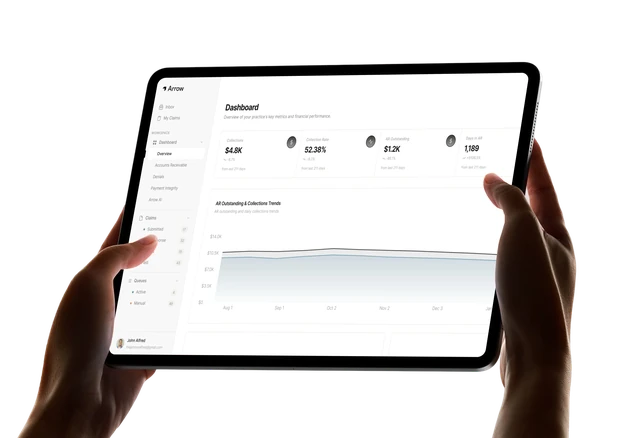
MindInventory developed ArrowHQ, a HIPAA-aware revenue cycle management platform serving US healthcare providers through a six-step denial workflow spanning ingest, diagnose, prepare, review, act and track. The platform integrated disconnected EHRs, clearinghouses and payer portals using Pinecone vector search and SQS queuing, with every claim action routed through a human biller for review and approval before submission.

Outcomes:

  • 85% reduction in claim denials
  • A/R days reduced from 45 to 18
  • 1.5B+ claims processed, supporting 100K+ clinicians
Read Case Study

State-Aware Claims Decisioning for a US InsurTech Company

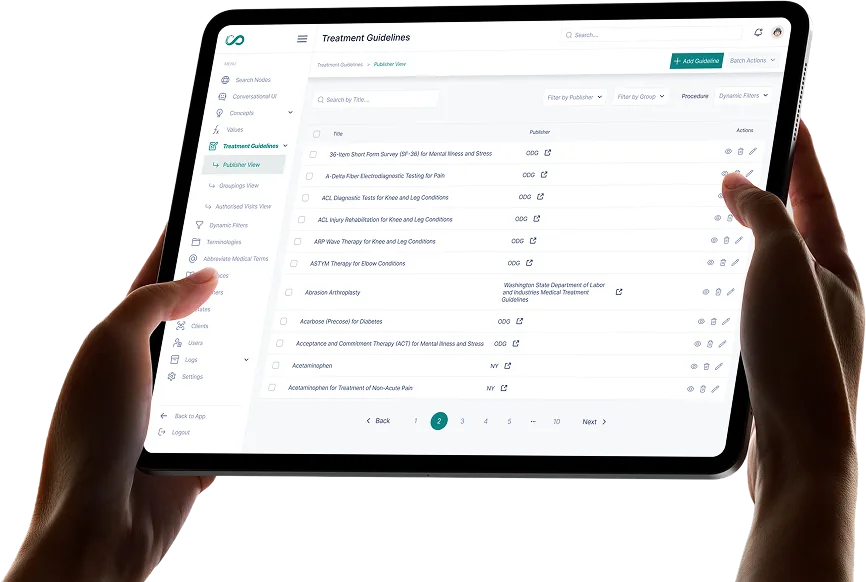
MindInventory developed ClaimClarity, an AI-powered medical decision support platform serving workers' compensation payers, third-party administrators and employers across the United States. The platform converted fragmented state treatment guidelines into structured clinical intelligence through natural language processing, machine learning and state-specific rule engines, with clinical data mapped to ICD-10, CPT, HCPCS, RxNorm and SNOMED so every determination traced back to a cited guideline.

Outcomes:

  • 20% faster claim processing
  • 25% reduction in manual claim handling
  • 33% lower overall claim costs
Read Case Study

Eight Questions We Would Ask on the First Call

These are the questions we open with. They’re also a fair test of any partner you’re considering, because a vendor who doesn’t ask them will estimate without knowing the answers.
What we ask
Why it decides the build

Which payment years are still open for you, and can you reconstruct the submission state for each?

Decides whether risk adjustment needs provenance rebuilt before anything else is worth doing

What is your accepted-versus-submitted encounter rate, and do you see it weekly or at quarter end?

A quarterly view usually means rejections are found too late to resubmit cleanly

Who holds the canonical member record today, the core, the risk adjustment vendor, or care management?

The most common cause of payer project overrun, and a reconciliation problem before it is a feature problem

Which of the four CMS-0057-F APIs has your core vendor committed to in writing, and on what date?

Separates a three-month gap-fill from a four-API programme

Does your member app read from a nightly extract or a live API?

A nightly file means members see yesterday's answer, and no front-end work fixes it

For a C-SNP member, can you evidence the initial HRA inside the 90-day window without a manual pull?

Initial HRA is due within 90 days of enrolment and reassessment within 365. Manual evidence doesn't survive an audit at volume

When a coder accepts a model-suggested HCC, is the model version stored with the decision?

Without it, you can show what was coded but not defend why

What does your platform agreement say about third-party integration and data extraction?

Integration depth is a commercial ceiling before it is a technical one

If you can't answer three of these, that's normal, and it's usually where we start.

Healthcare professionals shaking hands with an advisor in a meeting

The January 2027 Deadline

The CMS Interoperability and Prior Authorization Final Rule requires impacted payers, Medicare Advantage organisations included, to stand up FHIR APIs for patient access, provider access, payer-to-payer exchange and prior authorisation by 1 January 2027. (Source: CMS.)

We build against the named guides rather than an interpretation of them: CARIN Blue Button for patient access, Da Vinci PDex for provider access and payer-to-payer, and Da Vinci CRD, DTR and PAS for the prior authorisation stack.

Start with a paid gap assessment that produces a scope, a sequence and a cost. Many payers already serve part of the requirement from an existing FHIR estate, and we’d rather establish that than quote a four-API programme to a plan that needs one and a half.

Get a CMS-0057-F gap assessment

Medicare Advantage & Payer Platform Development Cost?

Work
Indicative Cost
Typical timeline
CMS-0057-F gap assessment
$15,000 – $30,000
3 – 5 weeks
A single FHIR API on an existing estate
$40,000 – $80,000
2 – 3 months
Full CMS-0057-F four-API programme
$150,000 – $300,000
6 – 9 months
Encounter data pipeline and rejection workflow
$60,000 – $120,000
3 – 5 months
One platform module end to end
$90,000 – $200,000
4 – 8 months
Standing platform team
$4,000 – $5,000 per engineer per month
Ongoing, month on month contract basis

What Moves A Number Within Its Cost Range Is Almost Always Integration

What your core system exposes, how many external systems are involved, and whether data moves in batches or in real time. Our healthcare software development services account for these complexities, including compliance review cycles and clinical validation time, upfront rather than introducing them as change requests six months into development.
Get a scoped estimate in 48 hours

Our Expertise in Medicare Advantage & Payer Platform Integrations

Nobody builds a Medicare Advantage platform on an empty estate.

These are the categories we are asked to connect to, and what the work usually turns on.

Core administration platforms. The integration surface varies enormously.

Some expose a documented API estate, some a database and a support contract, and some sit behind a BPaaS provider who owns the relationship. We establish which before estimating.

Clearinghouses and payer portals.

Claims and encounter submission paths, acknowledgement handling and the rejection routes behind them.

Risk adjustment and chart retrieval vendors.

What their API exposes decides whether retrieval status, chart images and coder decisions can live in one workflow or three.

Care management and utilization management tools.

Usually the second system holding a version of the member, and therefore the reconciliation question.

EHRs and clinical sources.

Epic, Oracle Health, athenahealth and MEDITECH, through HL7 v2, FHIR R4 or R5, or the vendor’s own API, depending on what your access allows.

The Stack Our Payer Engineers Work In

FHIR and interoperability

HAPI FHIR
Firely
Google Cloud Healthcare API
Azure Health Data Services
Mirth Connect
Redox
Redox

SMART on FHIR EDI and claims

X12 parsers
Translators

Clearinghouse and payer portal integration Data and analytics

Snowflake
Databricks
Redshift
PostgreSQL

Azure Synapse AI/ML

PyTorch
spaCy
LangChain
Amazon Bedrock
Google Vertex AI

Microsoft Foundry Backend and frontend

Python
Node.js
Java
Golang
React
Angular

Next.js Cloud and platform

AWS
Azure
GCP
Docker
Kubernetes
Terraform

When to Build, Buy, or Configure Your Platform

Your situation
Usually the right answer
You sell MA technology and the capability is your product
Build. It is what customers are paying you for, and a configured product caps what you can differentiate on
A capability exists in your core and covers most of the need
Configure. Build only the delta, and only where the delta is operationally material
A point vendor covers it well and integrates cleanly
Buy, and spend the engineering budget on the reconciliation layer instead
Regulation requires it by a fixed date and the vendor roadmap is vague
Build the gap, scoped from what you already have
You are a plan under roughly 10,000 members
Configure or buy. A custom build rarely returns the investment at that scale, and we’ll say so

The Best Way to Work With Us

Many of our healthcare clients already have established product teams and active development roadmaps. MindInventory strengthens their existing capabilities with engineers who understand Medicare Advantage workflows, encounter data reconciliation, FHIR integrations, and the complexities of payer platform development.

Domain Engineers Inside Your Team

You add Medicare Advantage engineers to your existing team, working in your sprints, your repo and your process. You interview and approve every engineer before they start. A technical project manager with regulated healthcare delivery experience is assigned to the engagement.

Best when you have a roadmap and not enough capacity, or when the gap is specific: someone who has built encounter reconciliation before, someone who has shipped a FHIR API against a payer data model.

The Roles We Staff

Medicare Advantage Business Analyst

Turns plan operations and CMS requirements into something engineers can build against

Payer Solution Architect

Data model, integration architecture and the FHIR layer

Risk Adjustment Engineers

HCC capture, suspect logic, coding workflow, chart review pipelines

Encounter Data and EDI Engineers

X12 submission pipelines, rejection handling, RAPS-to-EDPS reconciliation

Interoperability and FHIR Engineers

CMS-0057-F APIs, CARIN and Da Vinci guides, FHIR modelling over payer data

Core Administration Engineers

Membership, enrolment, premium billing, claims intake and payment

Care Management and UM Engineers

care plans, interdisciplinary care teams, SNP model of care, prior authorisation

AI/ML Engineers

Chart review models, NLP over clinical text, risk and quality analytics

Data Engineers

HEDIS pipelines, supplemental data, warehouse and lakehouse builds, Star Ratings instrumentation

QA Engineers

Payer workflows tested at operational pace, not just against scripts

DevOps and Cloud Engineers

HITRUST-grade environments on AWS, Azure or GCP

Product Designers

Member and provider portals, and the internal tooling coders and care managers use all day

Why Teams Choose Us for Payer Work

As a healthcare software development company, we build scalable, secure Medicare Advantage and payer platforms that streamline claims, membership, billing, and care management. Our team delivers FHIR-based integrations and customized solutions aligned with your operational and compliance requirements, from development to ongoing support.
Healthcare software engineer smiling at his desk with code open on two monitors

We Have Built The Whole Platform, Not A Module Of It

Core administration, risk adjustment and quality, and health management on one FHIR data store. Most partners bidding for this work have built one of the three.

A Domain Team, Not A General Team With A Payer Deck

Our team of 126 dedicated healthcare experts works exclusively on healthcare projects, bringing deep domain knowledge across payer systems, clinical workflows, and integrations.

Procurement-Ready On Day One

We hold the healthcare security and quality credentials a plan’s vendor risk team assesses against, with certificates and reports provided on request. It shortens the review. It doesn’t remove it.

We'll Tell You Not To Build

If configuring your core or buying a point vendor serves you better, we’ll say so during scoping. We have talked clients out of builds, and several came back later with the right project.

Procurement-Ready Before the First Sprint

MindInventory holds HITRUST, ISO 13485, ISO 27001:2022, ISO 42001, ISO 9001:2015 and a SOC 2 Type II attestation. Certificates and scope statements are provided on request. No accrediting body issues a HIPAA certification, and a partner claiming one is telling you something about their experience.
A BAA is executed before any PHI access. Engineers work inside access-controlled environments provisioned for the engagement, never on local machines, with access granted per named individual and revoked on rotation. Most development runs on de-identified or synthetic data.
Code, model weights, training pipelines, evaluation sets and documentation are assigned to the client in the service agreement. Knowledge transfer to an in-house team or another vendor is scoped into the engagement.

Client Testimonial

Ahmed Omar
Ahmed Omar CEO, Founder Sully.AI
MindInventory built the engine behind our multi-agent clinical AI platform. They brought deep EHR integration expertise across Epic and athenahealth, along with the human-review safeguards clinical software demands and delivered a secure platform that fits into our existing workflows without disruption.
Roshan Patel
Roshan Patel CEO, Founder ArrowHQ
We worked with MindInventory to build our revenue cycle management platform for claim denials. The team brought our disconnected EHRs, clearinghouses and payer portals into one clear workflow, from ingesting a denial to tracking it through resolution, and kept our billers in control by having them review and approve every claim action. The platform was built with HIPAA requirements in mind and runs reliably in day-to-day use.
Jamie LaPaglia
Jamie LaPaglia CEO, Founder ClaimClarity
Our reviewers used to check every claim against state guidelines by hand, and that was slow and hard to scale. MindInventory understood the problem quickly. The platform they built reads those guidelines, organizes them into something searchable, and shows the exact guideline behind each recommendation. Our team trusts it because they can always see why a decision was made.
Dr. Amreesh Khanna
Dr. Amreesh Khanna CEO, Founder OraQ AI
Most dental AI tools look at an X-ray and stop there. We needed a platform that brought patient history, imaging and clinical findings together, so every exam could be consistent and risk based. MindInventory understood that from the start. They built the regulatory requirements into the architecture from day one instead of patching them in later, which saved us a painful rework.
Sameer Sontakey
Sameer Sontakey Co-Founder & CEO BioStrap
Most wearable platforms throw away the raw signal to save on storage. We didn’t want that, because our researchers need the real data. MindInventory built the app, the cloud pipeline and the dashboard to keep it intact from capture to analysis, and they were easy to work with throughout.
Dmitriy Starson
Dmitriy Starson CEO Passio.ai
We worked with MindInventory to build the Nutrition AI behind our food logging technology. They delivered a visual food database that logs daily nutritional intake from a photo, with portion size estimation and packaged-food barcode recognition built in. The platform is packaged as an SDK that third-party health and wellness apps can integrate easily, and the team was professional and reliable from start to finish.

Healthcare Insights From Our Engineering Team

Explore our featured technology insights on news boards that are popular among our readers.

AI Clinical Documentation
post

AI Clinical Documentation: A Guide to Smarter Clinical Care 

A physician finishes a full day of appointments, but the work is not over. Patient encounters are complete, yet clinical notes still need attention. Medication details must be verified, histories…

post

Voice Technology in Healthcare: Use Cases, EHR Integration, and Cost Guide

The average physician works around 57.8 hours a week, yet only 27.2 hours go towards patient care. Most of their work is spent on maintenance of electronic health records(EHRs), and…

post

How AI Reduces Costs in Healthcare: Key Use Cases & Real Impact

Healthcare costs are rising fast. Systems are under pressure to do more with less. Margins are shrinking. Demand is growing. A large share of spending is still tied to inefficiencies.…

Frequently asked questions

Here’s a list of FAQs that will help you to know more about MindInventory.

A full one. Core administration, risk adjustment and quality, and health management, delivered on a shared FHIR data store for a US health technology company serving plans and risk-bearing groups. That engagement is under NDA, so we describe the scope, not the client.

Only when that is genuinely the project. Core replacement is a multi-year programme with a poor success rate, and more often the right answer is building the workflow and member-facing software around your existing core and integrating with it properly.

Usually, but it depends what you already have. Start with a gap assessment rather than a build estimate. Many payers already serve part of the requirement from existing FHIR infrastructure, and the remaining scope is smaller than the four-API programme they were quoted.

Both exist on our team and we staff for the former. Ask in the interview what a RAPS-to-EDPS reconciliation involves, or what happens when an encounter rejects on a provider NPI mismatch. The answer tells you more than a CV does.

Yes, and most engagements involve exactly that. What we build usually sits over a vendor stack, not in place of it. What matters is what their API actually exposes, which is worth establishing in discovery.

De-identified or synthetic data for most of the build. Where production data is required, engineers work inside access-controlled environments provisioned for your engagement, access is per named individual, and the BAA is signed before any of it begins.

Our strongest fit is MA technology companies, BPaaS firms and regional plans, not the national carriers who build in-house. Below roughly 10,000 members, a configurable product usually beats a custom build, and we’ll tell you that during scoping.

You do. Code, model weights, training pipelines, evaluation sets and documentation, assigned in the service agreement. We keep no retained components, and your platform runs without any licence from us.

Start With the Gap, Not the Build

Tell us which modules you have and where your team keeps running into the edges. Within 48 hours you get a written view of the options, an indicative cost for each, and the questions we would need answered to firm them up.

Healthcare technology consultants shaking hands during a meeting with a client