01
Claims and case resolution agents
Investigates a denial or exception across several systems, forms a root-cause hypothesis, assembles the response, routes it for approval.
MindInventory builds custom AI agents that complete multi-step work: systems that plan a task, call the tools and APIs your business already runs on, and take action inside your systems of record. We build them for enterprise workflows where a wrong action changes a record, a claim, or a dispatch, not just a conversation.
Agentic AI development is what we do daily, not a line we added last year. Six-agent clinical orchestration, denial resolution with a human approval gate, and governed industrial agents whose directives trace back to the telemetry behind them.
Trusted By Global Clients, Including Fortune 500 Companies


Every tool the agent can call is classified by reversibility before the first prompt is written.
No production build starts without a proof of concept running your real workflow.
Trajectory tests, tool-call assertions and the CI suite transfer at handover.
Completion rate, escalation rate and cost per completed task, tracked continuously.
70+
AI and ML specialists
300+
Engineering specialists
2700+
Projects delivered
1800+
Clients served
15+
Years in business

ISO 42001: 2023

ISO 27001: 2022

ISO 9001: 2015

SOC2 Type II

HIPAA

GDPR
Agents earn their cost where the work has real branching, a measurable outcome someone already owns, and systems that can actually be reached. Below are the agent types we build most often, grouped by the work they take over.
AI agent consulting applies when the workflow is not yet chosen. The work is mapping where the branching and the cost sit, sizing the return, and producing an autonomy target and a build-or-wait recommendation. Buying a build before this is how teams end up automating the process that was easiest to describe rather than the one that was expensive.
Custom AI agent development is the build itself, and it is closer to AI agent software development than to model work: reasoning, planning, memory, tool contracts and error handling designed around one workflow. Custom matters when the process is specific to your business or regulated. Where a workflow is generic, a platform agent configured well beats a bespoke one, and we will say so.
Enterprise AI agents describes deployment context, not different technology. It means agents operating inside SSO and role-based access, under procurement and audit requirements, against systems of record that cannot be replaced. That context, rather than model capability, is what separates a two-month build from an eight-month one.
AI workflow agents sit at the boundary with deterministic automation, handling processes that are mostly fixed with genuine exception branches. The agent handles the exceptions; the pipeline handles the rest.
Multi-agent systems apply when one agent’s tool set, context budget or permission scope stops being coherent. Detail in the orchestration section below.
AI agent integration is usually the largest line item: tool contracts, authentication, permission scoping and error semantics for every system the agent touches.
AI agent modernization covers replacing brittle rule-based automation, or rebuilding an early assistant that answers questions but cannot act, with something evaluable and governed.
Every project below is a production system with a named client, and the numbers come from after launch, not from a pilot. Most are still running, and several have been with us for years.
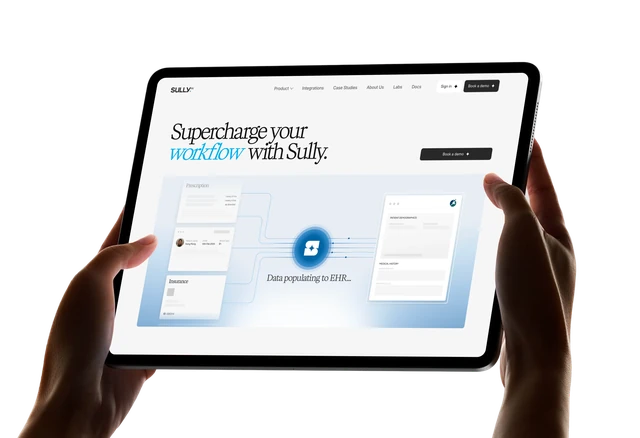
Six agents covering reception, triage, scribing, clinical consultation, medical coding and care coordination, with an orchestration layer that shares patient context and routes handoffs. Native Epic and athenahealth integration, HIPAA-ready, role-based access, full auditability. No drafted note, suggested code or triage recommendation enters the patient record without a licensed provider reviewing it. Each agent runs in an isolated container, so the coder can be retuned without touching the scribe.
Outcomes:
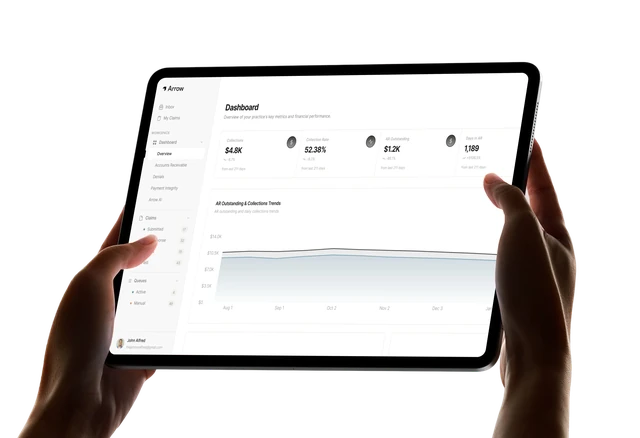
A six-step agentic workflow: ingest, diagnose, prepare, review, act, track. The agents identify likely root cause by matching against historical resolutions rather than exact denial codes, draft the fix, and assemble a ready-to-submit appeal package. A biller approves before anything leaves the system. The queue is ranked by dollar value, aging and recovery probability.
Outcomes:
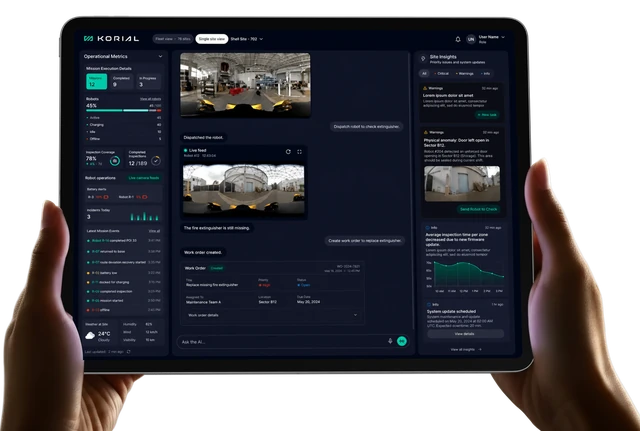
A hardware-agnostic intelligence layer above robots, drones and fixed sensors from several vendors, with Unreal Engine 5 digital twin simulation so autonomous missions are validated against a spatially accurate model of the site before deployment to live equipment. The agentic layer converts raw multimodal telemetry into bounded, auditable directives. Every directive traces back to the telemetry that produced it. Clients include Shell, BP and Evonik.
Outcomes:

Five stages. The order matters more than on a model build, because integration and authorization are first-phase concerns on an agent and last-phase concerns on almost everything else.
Agent pilots rarely fail on model quality. A demo runs one path. Production runs ten thousand, and the gap between an 85% completion rate and a 99% one is error handling, termination logic, state coherence and a defined escalation route.
If each step succeeds independently at rate r, the whole task succeeds at r to the power of n.
A 95% per-step rate sounds excellent and fails four times in ten on a ten-step task.
Real steps are not independent, so retries push results above the table and correlated failures push them below. What it does tell you is where the effort belongs: moving per-step reliability from 95% to 98% beats any amount of prompt polishing, and you get there through narrower tool contracts, stricter output schemas and fewer steps.
MAST, the multi-agent failure taxonomy from UC Berkeley’s Sky Computing Lab, analyzed over 1,600 execution traces across seven agent frameworks and grouped 14 failure modes into three categories. Their finding: most failures came from system design, not the model. We design against those three plus a fourth that appears once an agent touches a system of record.
In production
Loops, repeats a done step, never recognizes the task is finished
The control
Explicit termination conditions, step budgets, loop detection

Level 1
The agent may
Read, retrieve, queryHuman role
NoneLevel 2
The agent may
Rank and suggest, with reasoningHuman role
Decides and actsLevel 3
The agent may
Produce a complete artifactHuman role
Reviews and releasesLevel 4
The agent may
Act where an undo path existsHuman role
Post-hoc reviewLevel 5
The agent may
Act with external or financial effectHuman role
Confirms before execution, alwaysA multi-agent system splits work across specialized agents with an orchestration layer routing tasks and holding shared context. It is the right architecture less often than the market suggests, because splitting one agent into four multiplies the coordination surface.
One agent is enough when the tools are coherent, the task fits the context budget, and one person owns it. Split when at least two of these hold.
Tool selection accuracy degrades as the catalog grows
A real-time scribe and an overnight coding pass optimize for opposite things
An isolated level 5 agent is far easier to audit
Isolation is operational, not only architectural


Model choice is the least consequential decision here. We architect for portability so a model can be swapped without rebuilding around it. The orchestration, tool, state and evaluation layers are what you actually own.
Every tool classified by reversibility before orchestration is written. What the agent may do is answered in architecture, not discovered in production.
Benchmark set, trajectory tests, tool-call assertions, CI suite. Your team verifies quality after we leave without rebuilding the measurement apparatus.
A 300+ person engineering organization with fifteen years of systems integration behind it. Agent projects fail at the seam where the agent meets the system of record.
Risk classification, impact assessment, documented oversight and post-launch monitoring, per system.
Source code, tool definitions, prompts, pipelines, harnesses, documentation. Your data never trains models for anyone else.

Two weeks, at no cost. We review one agent use case against your actual workflow and data, classify every action it would take, and return a written recommendation with architecture options and a fixed estimate. Sometimes the recommendation is that a deterministic workflow would serve you better. You get that in writing too.
Five working days. We audit orchestration, tool design, evaluation coverage, authorization model and integration surface, and return a findings document naming what is missing and what it would take. Most stalled pilots are missing evaluation and error handling rather than a better model.
Explore our other related services to enhance the performance of your digital product

For deterministic, high-volume workflows where the sequence is known

For connecting AI into ERP, EHR and claims systems without replacing them

For evaluation, drift monitoring and keeping accuracy from slipping after launch

For EU AI Act classification, ISO 42001 alignment and decision provenance

Scaling operations while fostering innovation is a challenge AI agents are solving for enterprises. These intelligent solutions automate workflows and help organizations achieve faster responses, higher efficiency, and seamless operations.…
For decision-makers planning to invest in AI, the agentic AI vs. AI agents comparison is a critical topic of discussion. Agentic AI systems are designed to pursue goals, adapt, and…
Healthcare systems are under pressure like never before, with rising costs, clinician burnout, and fragmented patient data threatening both efficiency and care quality. That’s where AI in healthcare, specifically for…